Nature VS CULTURE
Be sure you understand
- The meaning and origins of the phrase All my relations
- The indigenous sense of all life as a community
- Differences between typical indigenous ways of understanding reality and humans' relation to nature and typical settler ways
- The Three C's of colonialism
- Wetiko
- How the way we live hides nature's reality from us - media over-consumption, cities, the division of labour, ignorance of science
- The basic science of greenhouse gases and global warming
- Mitigation strategies currently on the table
- What an individual could do personally to fight climate change - what David Suzuki's site and the lesson say is the #1 thing an individual can do
- Why eating less cheap meat could help fight climate change
- Normalization and how it relates to small individual lifestyle and attitude changes
BACKGROUND TERMS
GREENHOUSE GASES
Gases that trap heat in the atmosphere. There are several different types of greenhouse gases, but two in particular are responsible for climate change: carbon dioxide (CO2) and methane (CH4).
FOSSIL FUELS
Coal, Oil, Natural Gas. Fossil fuels include coal, petroleum, natural gas, oil shales, bitumens, tar sands, and heavy oils. All contain carbon and were formed as a result of geologic processes acting on the remains of organic matter.
CARBON SINKS
A carbon sink is any natural or technological process that absorbs carbon from the atmosphere. Trees, soils and oceans are the most important natural carbon sinks, but all three are limited in the amount of carbon they are capable of absorbing.
OPTIONAL READING
This lesson and the next look at issues about the environment, especial the climate crisis. These lessons will adopt a variety of approaches to analysing the strain between human systems (which we have evolved culturally and can be changed by humans) and the system of Nature (which has evolved on its own, and is not a human creation).
Let's start with the system of Nature, and some of the potentially dangerous ways the human species seems to be influencing it at presence. Many of you probably already know some of what will be discussed here, but some of you may not have studied it or thought too deeply about it. This lesson and the Canadian Encyclopedia reading are designed to bring everyone up to the same level of knowledge so that we can appreciate more fully the "Nature" side, which is largely hidden from us by our cities, our technologies, and our economies.
Indigenous humanity vs settler humanity
Nature is one of the most fundamental forces that shape our world. But it is very easy for us to lose sight of this. If you ask a typical Canadian what forces shape their world, they will likely start with economics and technology, and then may mention politics, or - if they are being a bit more critical - maybe racism, privilege, or some other human ideological power-structure. Living in cities, focusing on jobs and school, interacting with other human beings and pets but with few other living things directly, and spending so much time consuming unreal images from technology, we are inclined to forget that we're part of nature.
This is very different from how most indigenous people on Turtle Island (what we call North America) saw their relationship with the rest of nature. They understood that they were part of it, deeply connected to it. The Lakota people had a saying that has become popular with many indigenous groups today: "All my relations." This view of the world recognizes (as Western science now has) that we are all made of the same stuff, and all at least distantly related to one another. Not just all humans (though that's an important recognition, and difficult for many!), not just humans and other primates, but everything alive on the planet is related (this is science: humans share more than half of our DNA with bananas, for instance).
As the late novelist and essayist Richard Wagamese put it:
"All my relations," means all. When a speaker makes this statement it's meant as recognition of the principles of harmony, unity and equality. It's a way of saying that you recognize your place in the universe and that you recognize the place of others and of other things in the realm of the real and the living. In that it is a powerful evocation of truth. Because when you say those words you mean everything that you are kin to. Not just those people who look like you, talk like you, act like you, sing, dance, celebrate, worship or pray like you. Everyone. You also mean everything that relies on air, water, sunlight and the power of the Earth and the universe itself for sustenance and perpetuation. It's recognition of the fact that we are all one body moving through time and space together.
In 2024 at the age of 94, Oren Lyons, an elder of the Haudenosaunee nation, gave a fascinating speech in which he talked about this powerful way of seeing humans as part of nature:
From the perspective of most indigenous human beings, humans are actually part of a community of nature. Imagine if we all thought of it this way.
The European settlers, on the other hand, had inherited a culture where humans are all separate and in competition and where some are the important ones and some are the insignificant ones - a hierarchical world. In that world view, white people and Christians were considered the most "advanced" and "civilized" of humans; humans had been made in the image of God and were above the other animals; and our relatives were there to be studied as objects through science, to be controlled by force and by self-imposed discipline; to be exploited for gain; and to be turned into property. These are my own closest relatives who mostly thought this way, but that's how they've come to look to me.
They also, of course, felt "above" the rest of nature, and like it was theirs to do as they wished with. This may in part have come not from the white people's scientific and technological prowess, but from their religion, Christianity. The Creation Myth of the Bible makes it clear that everything else on Earth is there for man:
... and let [humans] have dominion over the fish of the sea, and over the fowl of the air, and over the cattle, and over all the earth, and over every creeping thing that creepeth upon the earth. So God created man in his own image, in the image of God created he him ... And God blessed them, and God said unto them, Be fruitful, and multiply, and replenish the earth, and subdue it: and have dominion over the fish of the sea, and over the fowl of the air, and over every living thing that moveth upon the earth. (Genesis 1: 26-28)
The Three C's of euromerican settler culture
The assumptions that the settlers brought with them to the "New World" (new to them, people were already living there), are often summarized as the three C's: : Colonization, Christianity, and Commerce. That's the handy catch phrase, so expect to see it on a quiz! The way I see it, though, the white Europeans really brought three key things with them that ensured they would come to dominate the indigenous populations: Technology, Christianity, and Capitalism.
The technology allowed them the upper hand in weaponry, machines, and other tools that would allow them to win by force. Christianity allowed them to feel justified in their "cultural imperialism" (attempt to take over and replace someone's culture with your own) - they were bringing "salvation" to the "savage" peoples of this continent. And meanwhile Capitalism encouraged them to see the resources among which the native people lived as potential property and sources of wealth. Both the land and the people were viewed by capitalists as exploitable resources.
The settler attitude toward the rest of nature, often including non-white human beings, was one of audacious self-interest: We are SUPERIOR (scientifically-technologically and/or because we are Christians); the rest of the world can be OBJECTIFIED and treated as OTHER and unrelated to us; the world is there to be OWNED and EXPLOITED for increasing our personal wealth (because we are CAPITALISTS), other humans are there to be EXPLOITED (sometimes OWNED!) because we are CAPITALISTS.
This was a clash of two cultures with fundamentally different world views and values. The indigenous view is close to modern enviromentalist attitudes, and the settler attitude is informed by the value of capitalism and human supremacy. I think of both conceptions as largely imaginary ways of seeing the world, but it seems possible to me that the indigenous views are more reality-based than those of the settler cultures, because most indigenous peoples have lived in close contact with the reality of nature. Beyond that, modern science, a product of Euromerican culture, seems to confirm some of how the indigenous people saw the reality of nature.
The differences in these two human ways of imagining reality were partly summed up by indigenous historian Jack Forbes, author of Columbus and Other Cannibals (1978), in a television interview in 1990:
Forbes is careful not to overgeneralize, but many of the ways people have come to categorize the differences in world view between the settlers and the native peoples do seem to tie in well with the contemporary clash of environmentalist and capitalist attitudes about humans in nature.
SUSTAINABILITY INDIGENOUS/ENVIRONMENTALIST |
SUPREMACY SETTLER/CAPITALIST |
"All my relations " |
Humans are above the rest of nature: we can control it and should view it as OTHER. |
We are part of the larger “community” of nature and we are related to and depend on all other living things and the environment as a whole. Other forms of life are our relatives, not fundamentally different from what we are. |
Natural resources should be exploited in order to increase personal wealth and economic growth. |
We need to respect the land, the environment, and other forms of life in order to survive and be true to our nature. |
Land is there to be owned as property, to increase one’s personal wealth and security. |
“Human nature” is another aspect of nature as a whole. |
“Human nature” is a different kind of thing from the rest of nature. |
Wetiko
Euromerican settlers have been used to considering themselves superior to indigenous North Americans, whom they generally considered primitive, savage, and wild. Maybe what they really had over the indigenous peoples was technology (weapons, machines, etc), and a massive will to dominate, overpopulate, exploit, extract, and consume in imperialist expansion. Modern North Americans are often surprised to learn how few indigenous people were envious of the settlers and wanted to cross over and become part of their power-driven culture of overconsumption.
From the start, the settler mentality - combining puritanical Christian fervour, imperialist conquest, and capitalist exploitation - seems to have struck most indigenous people as wrong-headed, spiritually evil even. In recent years, some indigenous thinkers have leveraged the Cree concept of the Wetiko spirit, as mentioned by Forbes in the video clip above, to describe the settler mindset.
Wetiko is an Algonquin word for a cannibalistic spirit that is driven by greed, excess, and selfish consumption (in Ojibwa it is windigo, wintiko in Powhatan). It deludes its host into believing that cannibalizing the life-force of others (others in the broad sense, including animals and other forms of life) is a logical and morally upright way to live.
....
Wetiko short-circuits the individual’s ability to see itself as an enmeshed and interdependent part of a balanced environment and raises the self-serving ego to supremacy. It is this false separation of self from nature that makes this cannibalism, rather than simple murder. It allows – indeed commands – the infected entity to consume far more than it needs in a blind, murderous daze of self-aggrandizement. Author Paul Levy, in an attempt to find language accessible for Western audiences, describes it as ‘malignant egophrenia’ – the ego unchained from reason and limits, acting with the malevolent logic of the cancer cell. (lnoor Ladha and Martin Kirk, "Seeing Wetiko: On Capitalism, Mind Viruses, and Antidotes for a World in Transition,“ Kosmos Quarterly Spring/Summer 2016)
The indigenous evil spirit Wetiko ties in with the views of environmentalists who see neoliberal economists not just as destructive, but as actually "insane." Could our comfortable and seemingly unbeatable way of life conceal a deep spiritual sickness and disconnection from reality and empathy for others? Many non-indigenous thinkers have also suspected this.
What is Global Warming?
If you would like to understand the background science a little better, you can start with the Canadian Encyclopedia article on Climate Change that is this week's suggested reading. The basic point is that "greenhouse gases" - especially carbon dioxide (CO2) and methane - are part of earth's atmosphere and when sunlight has hit the surface of our world and gets bounced back toward space, these gases deflect some of the reflected sunlight and send it back toward earth, keeping the atmosphere at the temperatures we are used to. Unfortunately, human activities involving the burning of fossil fuels and the overproduction of methane-releasing animals for meat are increasing the amount of greenhouse gases in the atmosphere, and this means the planet heats up more.
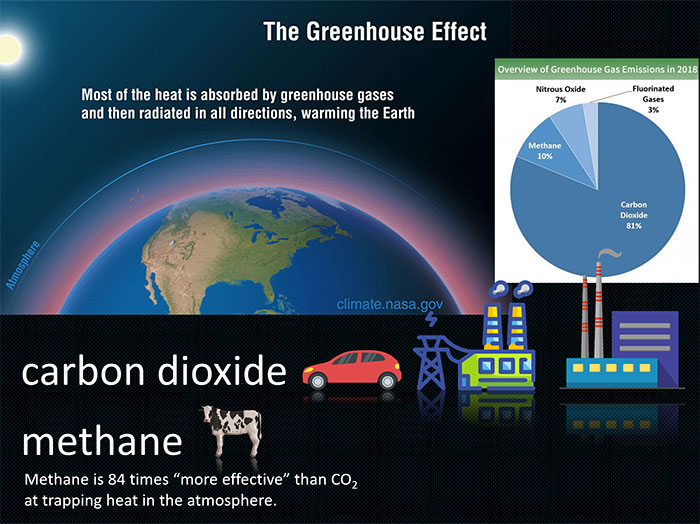
As temperatures rise, even slightly, various ecosytems change (melting icecaps, dying reefs, etc). If some organisms in the interdependent chain of life cannot survive, it throws off the delicate interaction of species and other species may perish, eventually leading to losses that humans care about (food sources, oxygen producers, etc) and potentially large environmental collapse, leaving people starving, sick, or unable to live in their new environments.
Dead media vs living reality
The invisibility of CO2 emissions and the relative lack of climate changes in Canada so far lead to our unawareness of the reality of them. Mostly we know reality through media and what we experience in our immediate environment. The rest of nature may not seem to be very important based on the typical hyperreal experiences of a city-dwelling, media-consumed person.
If you ask a typical Canadian what forces shape their world, they will likely start with economics and technology, and then may mention politics, or - if they are being a bit more critical - maybe racism, privilege, or some other human ideological power-structure. Living in cities, focusing on jobs and school, interacting with other human beings and pets but with few other living things directly, and spending so much time consuming unreal images from technology, we are inclined to forget that we're part of nature.
It was easier for an indigenous person living in nature to recognize the legitimacy of the idea of nature as a community of which we are a part. "All my relations" acknowledges humans' deep connection to the rest of life and the fact that we are really just one small part of it. Most of us city-dwellers in the Western world are almost wholly detached from that reality in our day to day existence. We may see ourselves as human beings, separate from and above nature.

If you would like to disrupt this blindness, I can recommend an entertaining and eye-opening book by science broadcaster Ziya Tong, The Reality Bubble (2019). Tong's book is a science-based onslaught on how delusional many of our ways of perceiving reality have become. Those of us in the developed world live in cities; our food comes to us packaged and processed, our garbage magically disappears once a week, our shit goes down the drain and we never have to think about it again. And of course, we spend a huge amount of our attention on distracting media and the seemingly inescapable work and economy that our technology has created for us and that our institutions - including Humber College - largely insist are the central focus of human existence.
But in fact - and the pandemic helped some of us to grasp this - we are animals: vulnerable, mortal, physical - desperately dependent on and interdependent with the rest of life on earth. We depend on the oceans, on the weather and the oxygen we breathe, on fresh water, on microorganisms within us and in the environment that even scientists don't fully understand.
The COVID-19 pandemic has been a wake-up call about some of this. Our lives were at risk not because we didn't have a good enough paying job but because we're animals, and an invisible microorganism can change everything, potentially kill us or those we love. In an effort to avoid the loss of human life and the collapse of our man-made health care systems, the economy can be drastically slowed down and we are forced to change our way of living because of this nasty little bug. I think there's a valuable lesson here about the basics of life, which privilged people in the wealthy nations of the world have largely been able to lose touch with.
Before the coronavirus and continuing alongside it we have the climate crisis. Most people are now aware that this poses a huge threat to our way of life, if not to our whole species and certainly other forms of life on earth. We are not machines or computers; we are part of life, animals that are intimately connected to the rest of life on earth in a network of interdependent relationships. All our relations. Arguably this truth about us trumps invented human ideologies such as democracy, capitalism, technocracy, religions, and all the rest. The reading in the next lesson by David Suzuki and Faisal Moola comes from a biocentric perspective that seems entirely consistent to me with the indigenous message of All my relations. We need to see the rest of life as our family with whom we have to live, not as something unlike ourselves that we can control and use as we see fit without any consequences.
Individual action vs systemic change
We will now take a closer look at what can be done to address the climate emergency.
There are four serious strategies humans have thought up so far for dealing with this "climate emergency." Three of them are things we can begin doing right now, the fourth is more of a dream for the more distant future. Debra Davidson in the Canadian Encyclopedia article talks about these as "mitigation strategies" - ways the damage can be mitigated (made less severe or destructive).
1. Reducing our greenhouse gas emissions (this is the one we can all do now)
This is the traditional solution, and the one we are already in a position to implement, though it will be hard and costly and really requires global cooperation that the world is not prepared for. The basic idea is this: we will use less energy, consume less. and switch as rapidly as possible to green energy solutions. Green energy is power that involves little to no carbon emissions, and fewer or no hengative impacts of other kinds on the environment. This is something individuals can do in smaller ways that would add up (drive less, consume less) and that governments and corporations will need to make happen (no more fossil fuel burning; reduced packaging and transportation, etc).
2. Carbon capture
The idea of this approach is that everywhere that carbon is released (cars, factories, etc) we install technology that captures the carbon and then we bury it, like other waste, so that it never gets into the atmosphere. The focus here is particularly on our power plants, many or most of which currently burn fossil fuels to generate our electricity. The carbon capture approach is being tried in some power plants, including one in Saskatechewan. The problem with it is that the method is expensive, and most governments (and voters) are still reluctant to commit the massive resources necessary to make it happen on a large scale. In some other major fossil fuel-burning countries it is not even being explored yet.
3. Reabsorption strategies
Forests, plants in general, and the planet's oceans naturally absorb carbon from the atmosphere. Thus, reforestation is an important step that can be taken to keep natural "carbon sinks" in place. On the other hand, something like the burning Amazonian rainforests are both actively creating carbon and destroying natural carbon absorbers. Hence the concern about that situation. There is some exploration into creating artifical carbon-absorption processes through technology, but these are probably still far in the future. In the meantime, planting trees and other carbon absorbing plants is a good step everyone can take, and that governments may explore on a more extensive level. In Toronto, home owners have long been obliged to let the municipal government plant trees on their property in order to add to oxygen production and carbon absorption in the city. This is one of the few cases where I find the government forces us to do stuff we might not want to do, but I am personally in favour of what they are forcing us to do. (They wrecked my front garden taking out a dead tree and then planting a new one months later, but I don't mind the way it is growing now.)
4. Geo-engineering (not a real option at this time)
In addition to those three strategies, which could be implemented now if enough of us demanded it and were willing to make some sacrifices, there is hope that in the future technology will give us forms of geo-engineering that will allow us artificially to create massive environmental changes through technology that would lower the carbon in the atmosphere or lower temperatures in some other way. Such techniques are still merely speculative, and like all human technological advances there are risks of unintended negative impacts that might be felt on the global scale. We'll return to such concerns about the impossibility of predicting consequences of technology in the lesson on biotechnology in week 13.
We can voluntarily reduce our carbon impact today by significantly cutting back our individual consumption and changing our lifestyles (see below); as well and - more importantly - if we believe in the science and want to be proactive we need to influence our governmental policy-makers to make this a top priority, enforce carbon emissions reductions on manufacturing and other large-scale industries, and start converting to non-fossil-fuel sources of energy immediately.
What can you personally do about climate change
Assuming you accept that climate change is real, that it is caused by humans, and that it is dangerous for our future (and much of the other life on the planet) do you have any sense of what you personally could do if you wanted to fight against it?
When we've polled students in the past, the number one answer is often recycling. Unfortunately, recycling in its present state - though it is a good idea for other reasons - will do little to combat climate change. There are many other things we can do that are more likely to have a larger impact.
The Canadian broadcaster and environmentalist David Suzuki, co-author of a reading we will look at next week, has a foundation whose web site discusses a number of actions worth taking. They can be broadly divided into political action and lifestyle/culture changes.
According to the Suzuki Foundation, the single most important thing an individual can do is take political action. We need to elect leaders who take climate change seriously and are getting a message from voters that it is a top priority.
Political action is the more urgent, and involves signing petitions, public demonstrations, writing to your representatives, and sharing information about such activity on your social media. Finally, if you care about making the climate safer, you should be voting for parties that prioritize this issue.
Lifestyle changes involve things like consuming less, reusing things, repairing things, driving less, and eating less meat. Some of these are discussed in more detail below. A single individual's lifestyle changes may have little impact by itself, but combined with millions of other single individuals changing, they will. An important aspect of changing your lifestyle is normalizing these lifestyle changes. The more people who shop thrift stores instead of fast fashion, the more people who go vegan, the more people who ride bikes, the more normal and "right" these activities will seem to others, and the more it becomes the standard for our society, instead of a seemingly crackpot fringe.
It is no exaggeration to say that our hyperconsumption habits in the "First World" and the ever-increasing manufacture of unnessary consumer goods in the developing world are major contributors to the current emergency. Most of our consumer goods in the contemporary world involve terrible impacts on carbon levels. Natural resources are destroyed; manufactuing burns coal or uses power that comes from carbon-releasing sources; we transport the products over incredible distances (all the way from China to Canada, for example); and the products are generally over-packaged in non-biodegradable plastic or paper that should either be composted or recycled but often isn't. The next time you buy a bag of candies, in which each candy has been individually wrapped in plastic, think about how much processing had to go into it and how much waste is involved - for what is also probably an unhealthy and unnecessary consumer good. (Does it even really taste all that great?) It may be good for the economy, but it is terrible for the ecology.
Thus, one of the 10 best things you can do on the list provided by David Suzuki's web site is Consume less. Of course, we have little else but consumption to bring meaning to our lives in the Western world, and we have been told that our consumption is necessary for the economy and that everyone will get richer the more we consume. This may be partly true for a time in a limited economic model, but as we'll see David Suzuki insists that it is no longer a sustainable model for our species.
Drastically reduce your consumption of "cheap meat"

A chicken-processiong and -packaging plant in China. Sometimes chickens are shipped from Canada to China for cheaper processing and then shipped back to Canada or to other parts of the world.
The factory production of meat and dairy has a huge impact on greenhouse gas emissions. Cattle produce enormous amounts of methane; forests are destroyed to create grazing land, removing natural carbon sinks; and meat and dairy are processed and transported large distances in ways that add to the carbon footprint.
I am going to spend a little more time here on the "cheap meat" industry because it strikes me as a very clear example of humanity out of control - but out of sight from the average citizen. In the book The Reality Bubble that I mentioned above, Ziya Tong takes the reader through a dizzying and nauseating survey of how the meat industry works so that everyone in a wealthy country like Canada can have cheap meat at every meal if they want to. I'll leave it to you to decide whether you want to know about the horrors that the animals endure - most of us would rather not know - but even just the scale at which meat production happens worldwide is monstrous:
Today, there are over one billion domesticated pigs on Earth, one and a half billion domesticated cows, and, according to annual slaughter numbers by the UN’s Food and Agriculture Organization, almost sixty-six billion chickens. What this means, as George Musser, an editor at Scientific American, put it, is that “almost every vertebrate animal on earth is either a human or a farm animal.” Including horses, sheep, goats, and our pets, 65 percent of Earth’s biomass is domestic animals, 32 percent is human beings, and only 3 percent is animals living in the wild. (Tong 2019)
In other words, most of the animal weight on earth at present (97%) is human beings and the animals we have domesticated, mainly in order to eat them! This is one example of how radically humans have changed nature and diminished biodiversity.

Source: Oliver Milman, "Meat accounts for nearly 60% of all greenhouse gases from food production, study finds," The Guardian Mon 13 Sep 2021.
A 2021 study publicized in The Guardian indicated that meat accounts for nearly 60% of all greenhouse gases from food production. Cattle release huge amounts of the greenhouse gas methane in their burps and farts, and the factories and transportation that make make meat comparatively cheap are large contributors to carbon release.
The entire system of food production, such as the use of farming machinery, spraying of fertilizer and transportation of products, causes 17.3bn metric tonnes of greenhouse gases a year, according to the research. This enormous release of gases that fuel the climate crisis is more than double the entire emissions of the US and represents 35% of all global emissions, researchers said.
“The emissions are at the higher end of what we expected, it was a little bit of a surprise,” said Atul Jain, a climate scientist at the University of Illinois and co-author of the paper, published in Nature Food. “This study shows the entire cycle of the food production system, and policymakers may want to use the results to think about how to control greenhouse gas emissions.”
The raising and culling of animals for food is far worse for the climate than growing and processing fruits and vegetables for people to eat, the research found, confirming previous findings on the outsized impact that meat production, particularly beef, has on the environment. (Oliver Milman, "Meat accounts for nearly 60% of all greenhouse gases from food production, study finds," The Guardian Mon 13 Sep 2021)
The desire to provide everyone on the planet with a steady diet of meat protein has led to grisly overexploitation of animals and a mammoth impact on the levels of greenhouse gasses. We now find both environmentalists and animal rights activists encouraging everyone to reduce our meat consumption, avoid "cheap meat" (processed and/or mass marketed meat, such as is used in fast food, frozen and canned food, and generally in supermarket meat) and cheap dairy (which is also an industry full of cruelty with a significant impact on carbon levels). The ideal, according to environmentalists, would be for us to embrace veganism, or hugely reduce our dairy consumption and eat meat at most once or twice a week.
- Eat less meat and dairy; go vegan when possible
- If you do eat meat or dairy, buy local, organic, naturally raised products whenever possible
- Don’t waste food; consume more carefully
- Grow your own (I've done it; it's fun and really makes you appreciate what goes into the food we eat)
Don’t invest in fossil fuels; don’t invest in cryptocurrencies and NFTs; don’t invest in AI
It's started to become very clear that the Internet, Cloud storage, and server farms running our favourite platforms actually use significant energy and thus make a noticeable impact on carbon emissions. Blockchain ownership technologies also use huge amounts of energy for the sole purpose of maintaining ownership of entities that are entirely virtual.
Now that generative AI is ramping up the use of computing energy, and that the server farms running the machines that make it possible are requiring absurd amounts of fresh water in order to cool the hot-running servers even using AI becomes an environmental issue. Until there are greener sources of energy common and cooler computing technologies, it is not ethical to invest in blockchain or AI, or at least no more ethical than investing in fossil fuels. If you care about the environment, it's another reason to stay off your phone consuming media, and to limit your use of AI tools. It typically takes 10 times as much energy for AI to find answers to your questions as it does for you to google for those answers yourself.
Normalization and sustainable living
You may well say that it will make little difference if you personally consume or drive less, or stop eating cheap meat - and of course you would be right that if one person does these things, it will have no impact. But there is another good reason to behave better.
Normalization is the cultural process through which new social norms evolve and become established. Our values change as a society, for better and for worse. For instance (for better), it used to be quite common, even when I was a kid, for people to smoke cigarettes, and most people considered it normal. Gradually, over the course of my lifetime, education, government action, and the media have made smoking seem much less cool, and today it is actually considered somewhat abnormal and unpopular to be a smoker. Another example (for better), when I was a young man there were almost no openly homesexual characters ob tv. Then in the 1990s there were suddenly sitcoms centered on gay men and eventually much more queer content on tv and streaming services. Seeing these characters in the media helped normalize homosexuality in the real world world, and made many more people who in the past might have been homophobic warm up to gay people in real life.
What we did with smoking could be done with carbon emissions and hyperconsumption. A combination of governmental action, media representation, and personal lifestyle changes could make it normal to live sustainably and care about the environment. You choosing not to eat cheap meat, shopping at thrift stores, or taking transit would help model this new norm for other people - help to normalize caring about the environment and our impact on it.
I would like to suggest that the imagined realities of indigenous environmentalism and of biological and geological science are more reality-based than the imaginary ideal of infinite economic growth on a finite planet. To believe in climate change in the world we live in and to believe that we can avoid the worst of it requires a massive leap of the imagination on our parts. We are trapped in the imaginary world of media consumption, unlimited growth, and consumer capitalism as the meaning of life. These are many people's "religion" now. But I believe we are badly at risk and that we need to imagine ourselves out of this culture we have created where we see ourselves as disconnected from the rest of nature, and as inevitably destructive and self-destructive consumers and exploiters, if we possibly can …
More next week.