WEEK 12: Meaning (Viktor Frankl)
Be sure you understand
- How Frankl suggests you should think about yourself and the world in order to survive situations of terrible suffering
- Ways Frankl kept his spirits up and kept himself going in the concentration camp
- Happiness vs meaningfulness – the results of studies reviewed by Esfahani Smith
Background questions for this lesson:
- Would you rather have a life that is shallow but happy or would you rather have a life that is challenging but meaningful?
- Does adversity contribute to a taste for meaning?
- Do we substitute meaning for happiness when we don’t have happiness, in order to survive?
- Is meaning a way of making suffering bearable and satisfying?
OPTIONAL READING
Emily Esfahani Smith, "There's more to life than happiness" The Atlantic, January 9, 2013
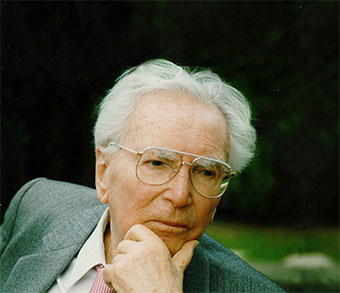
Viktor Frankl was an Austrian Jew, a neurologist and psychologist. He survived interment in Nazi concentration camps during World War II. His wife and parents all died in the camps, along with many other people he knew. Frankl is a guide to staying whole through the toughest life has to throw at you.
Frankl survived the concentration camps, and in 1946 (right after the end of the war) he published a best-selling book, Man’s Search for Meaning, which was partly devoted to explaining how he had survived (mentally and emotionally) the ordeal of the camps. Many survivors of the camps had been broken forever by the trauma of that experience of cruelty, inhumanity, and deprivation. Even if they survived physically, they were emotionally wrecked for life; they had lost hope in humanity, and they felt their lives had been ruined by the hate and meaningless suffering they had gone through.
Frankl devoted his time in the camps to trying to help those who were suffering, giving them counselling and urging them to try to find meaning in the terrible experience they were all going through. He encouraged them to hope that the hell would come to an end and that they could grow and learn and be stronger for having gone through the ordeal. When Frankl was released, despite having lost his beloved wife and many other people, he vowed to use his own experiences of trauma and loss to flesh out a new form of psychological treatment: logotherapy. His therapy focuses on the need to finding meaning in your life, even when you are suffering, things seem hopeless, and you feel abandoned by God and your fellow man.
Frankl's attitudes go along with the harder aspects of Existentialism, as explained last week. He thought that it is up to each human being to find meaning in their lives. He adopted one of Nietzsche's sayings as a guide to dealing with situations where life is too horrible and you are suffering to the point of wanting to end it all: “He who has a why to live for can bear almost any how.”
Let's start by reading an excerpt from his experiences in the Auschwitz concentration camp. As you read, I encourage you to make note of the ways Frankl kept his spiritis up and used his mind to manage his suffering.
Viktor Frankl (1963). Man's search for meaning. New York, NY: Washington Square Press, Simon & Schuster. (pp. 57-64)
“Let me tell you what happened on those early mornings when we had to march to our work site.
There were shouted commands: ‘Detachment, forward march! Left-2-3-4! Left-2-3-4! Left-2-3- 4! Left-2-3-4! First man about, left and left and left and left! Caps off!’ These words sound in my ears even now. At the order ‘Caps off!’ we passed the gate of the camp, and searchlights were trained upon us. Whoever did not march smartly got a kick. And worse off was the man who, because of the cold, had pulled his cap back over his ears before permission was given.
We stumbled on in the darkness, over big stones and through large puddles, along the one road running through the camp. The accompanying guards kept shouting at us and driving us with the butts of their rifles. Anyone with very sore feet supported himself on his neighbor's arm. Hardly a word was spoken; the icy wind did not encourage talk. Hiding his hand behind his upturned collar, the man marching next to me whispered suddenly: "If our wives could see us now! I do hope they are better off in their camps and don't know what is happening to us."
That brought thoughts of my own wife to mind. And as we stumbled on for miles, slipping on icy spots, supporting each other time and again, dragging one another on and upward, nothing was said, but we both knew: each of us was thinking of his wife. Occasionally I looked at the sky, where the stars were fading and the pink light of the morning was beginning to spread behind a dark bank of clouds. But my mind clung to my wife's image, imagining it with an uncanny acuteness. I heard her answering me, saw her smile, her frank and encouraging look. Real or not, her look then was more luminous than the sun which was beginning to rise.
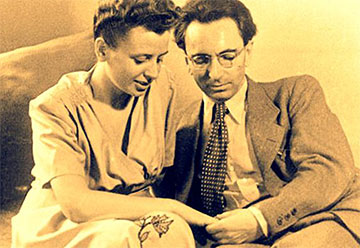
A thought transfixed me: for the first time in my life I saw the truth as it is set into song by so many poets, proclaimed as the final wisdom by so many thinkers. The truth--that love is the ultimate and the highest goal to which man can aspire. Then I grasped the meaning of the greatest secret that human poetry and human thought and belief have to impart: The salvation of man is through love and in love. I understood how a man who has nothing left in this world may still know bliss, be it only for a brief moment, in the contemplation of his beloved. In a position of utter desolation, when a man cannot express himself in positive action, when his only achievement may consist in enduring his sufferings in the right way--an honorable way--in such a position man can, through loving contemplation of the image he carries of his beloved, achieve fulfillment. For the first time in my life, I was able to understand the words, "The angels are lost in perpetual contemplation of an infinite glory."
In front of me a man stumbled and those following him fell on top of him. The guard rushed over and used his whip on them all. Thus my thoughts were interrupted for a few minutes. But soon my soul found its way back from the prisoners’ existence to another world, and I resumed talk with my loved one: I asked her questions, and she answered; she questioned me in return, and I answered.
‘Stop!’ We had arrived at our work site. Everybody rushed into the dark hut in the hope of getting a fairly decent tool. Each prisoner got a spade or pickax.
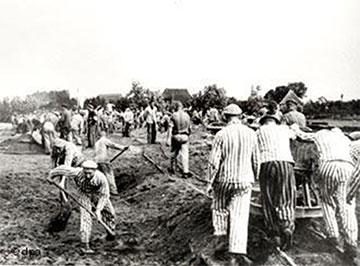
‘Can’t you hurry up, you pigs?’ Soon we had resumed the previous day’s positions in the ditch. The frozen ground cracked under the point of the pickaxes, and sparks flew. The men were silent, their brains numb.
My mind still clung to the image of my wife. A thought crossed my mind: I didn't even know if she were still alive, and I had no means of finding out (during all my prison life there was no outgoing or incoming mail); but at that moment it ceased to matter. There was no need to know; nothing could touch the strength of my love, and the thoughts of my beloved. Had I known then that my wife was dead, I think that I still would have given myself, undisturbed by that knowledge, to the contemplation of that image, and that my mental conversation with her would have been just as vivid and just as satisfying. "Set me like a seal upon thy heart, love is as strong as death." …
This intensification of inner life helped the prisoner find a refuge from the emptiness, desolation and spiritual poverty of his existence, by letting him escape into the past. When given free rein, his imagination played with past events, often not important ones, but minor happenings and trifling things. His nostalgic memory glorified them and they assumed a strange character. Their world and their existence seemed very distant and the spirit reached out for them longingly: In my mind I took bus rides, unlocked the front door of my apartment, answered my telephone, switched on the electric lights. Our thoughts often concentrated on such details, and these memories could move one to tears.
As the inner life of the prisoner tended to become more intense, he also experienced the beauty of art and nature as never before. Under their influence he sometimes even forgot his own frightful circumstances. If someone had seen our faces on the journey from Auschwitz to a Bavarian camp as we beheld the mountains of Salzburg with their summits glowing in the sunset, through the little barred windows of the prison carriage, he would never have believed that those were the faces of men who had given up all hope of life and liberty. Despite that factor—or maybe because of it—we were carried away by nature’s beauty, which we had missed for so long.
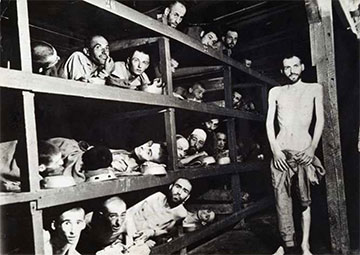
In camp, too, a man might draw the attention of a comrade working next to him to a nice view of the setting sun shining through the tall trees of the Bavarian woods (as in the famous water colour by Durer), the same woods in which we had built an enormous, hidden munitions plant. One evening, when we were already resting on the floor of our hut, dead tired, soup bowls in hand, a fellow prisoner rushed in and asked us to run out to the assembly grounds and see the wonderful sunset. Standing outside we saw sinister clouds glowing in the west and the whole sky alive with clouds of ever-changing shapes and colours, from steel blue to blood red. The desolate gray mud huts provided a sharp contrast, while the puddles on the muddy ground reflected the glowing sky. Then, after minutes of moving silence, one prisoner said to another, ‘How beautiful the world could be!”
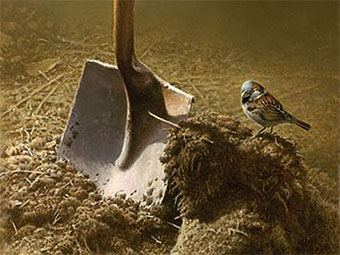
Another time we were at work in a trench. The dawn was gray around us; gray was the sky above; gray the snow in the pale light of dawn; gray the rags in which my fellow prisoners were clad, and gray their faces. I was again conversing silently with my wife, or perhaps I was struggling to find the reason for my sufferings, my slow dying. In a last violent protest against the hopelessness of imminent death, I sensed my spirit piercing through the enveloping gloom. I felt it transcend that hopeless, meaningless world, and from somewhere I heard a victorious ‘Yes’ in answer to my question of the existence of an ultimate purpose. At that moment a light was lit in a distant farmhouse, which stood on the horizon as if painted there, in the midst of the miserable gray of a dawning morning in Bavaria. ‘Et lux in tenebris lucet’—and the light shineth in the darkness. For hours I stood hacking at the icy ground. The guard passed by, insulting me, and once again I communed with my beloved. More and more I felt that she was present, that she was with me; I had the feeling that I was able to touch her, able to stretch out my hand and grasp hers. The feeling was very strong: she was there. Then, at that very moment, a bird flew down silently and perched just in front of me, on the heap of soil which I had dug up from the ditch, and looked steadily at me.”
How to survive when life doesn’t seem to be worth living
What did you think of how Frankl managed his inner life while on the forced work crew, and of the ways he talks about the experience of positive things in this place of despair? Frankl found ways of dealing with the nightmare that he felt other people could learn from in their own times of suffering.
You would be justified in saying he spent a lot of time fantasizing about things that were not real. That is part of his point: the mind is powerful and imagination is a force that can keep a person alive and hold them together when reality is soul-destroying, painful, and uncertain.
An Epicurean in Auschwitz
I often think about the ideal life as laid out by Epicurus in the lesson from two weeks ago, and I wonder how an Epicurean would fare in a concentration camp. An optional side reading for this week is an article by Emily Esfahani Smith, "There's more to life than being happy." An admirer of Frankl, Esfahani Smith wants to delve deeper into the relationship between happiness and meaning.
She starts off by talking about Frankl’s view that meaning is more important than happiness for human survival. She looks at recent sociological research that asks whether people who have meaningful lives are happy and whether people who have happy lives feel their lives are meaningful.
The results she discusses are somewhat alarming. Meaningfulness, it turns out, may often come at the expense of pleasure and happiness. According to Viktor Frankl, to be human, and not just an animal, one must live not just for oneself but for other people, and not just for the moment but in a way that is more meaningful than that, tied to others, and to human history and the future of humanity.
In Man's Search for Meaning, Frankl talks about two suicidal inmates he encountered there. Like many others in the camps, these two men were hopeless and thought that there was nothing more to expect from life, nothing to live for. "In both cases,” Frankl writes, "it was a question of getting them to realize that life was still expecting something from them; something in the future was expected of them." For one man, it was his young child, who was then living in a foreign country. For the other, a scientist, it was a series of books that he needed to finish. (Esfahani Smith, p. 2)
Esfahani Smith now quotes a passage from Frankl's book:
This uniqueness and singleness which distinguishes each individual and gives a meaning to his existence has a bearing on creative work as much as it does on human love. When the impossibility of replacing a person is realized, it allows the responsibility which a man has for his existence and its continuance to appear in all its magnitude. A man who becomes conscious of the responsibility he bears toward a human being who affectionately waits for him, or to an unfinished work, will never be able to throw away his life. He knows the "why" for his existence, and will be able to bear almost any "how.“ (qtd in Esfahani Smith, p. 2)
In the last line, as mentioned earlier, Frankl is actually paraphrasing Nietzsche. “He who has a why to live for can bear almost any how.”
Meaning for Frankl comes from connection to other people. It could be loved ones; it could be friends; it could be your "public"; it could be the people you take care of; the people you teach (;-); the whole of humankind; the people of the past; the people of the future. Connection, being needed, being attached, gives one's life meaning, and meaning gives one the courage to survive, even when "life doesn't seem worth living."
Belonging, and a purpose. Ultimately, having a purpose involves others, at least as Frankl saw it.
WIll meaning make you happy?
The results of studies Esfahani Smith reviews are worth thinking about. It seems that happy people are more likely to be leading meaningless lives, and that meaningful lives may be less happy! She quotes from and discusses a sociological study that suggests that there might be two kinds of people in the world: some people devote their life to their own happiness (consistent with the Epicurean goal of pleasure), while others want to live a meaningful life, which ends up in a lot of focus on others.
There are certainly differences between these people and these lives. Happiness without meaning characterizes a relatively shallow, self-absorbed or even selfish life, in which things go well, needs and desire are easily satisfied, and difficult or taxing entanglements are avoided. (Baumeister et al, “Some Key Differences between a Happy Life and a Meaningful Life,” qtd in Esfahani Smith)
Those leading happier lives, she says, tend to be takers, ready to receive whatever others have to offer, without a care. Those leading more meaningful lives tend to be givers, focused on other people and what they can give to them.
Are people with children more happy than people without? What do you think? In the studies surveyed by Esfahani Smith, those with children reported themselves as less happy than those without. On the other hand, they also reported themselves as having more meaningful lives.
Despite the suggestion that meaning might actually make you less happy, Esfahani Smith follows Frankl in his faith that meaningfulness is important for a fully human life. Meaningfulness is deep; it lasts. Happiness tends to be a fleeting emotion, as Esfahani Smith see it.
Meaning, on the other hand, is enduring. It connects the past to the present to the future. "Thinking beyond the present moment, into the past or future, was a sign of the relatively meaningful but unhappy life," the researchers write. "Happiness is not generally found in contemplating the past or future." That is, people who thought more about the present were happier, but people who spent more time thinking about the future or about past struggles and sufferings felt more meaning in their lives, though they were less happy. (Esfahani Smith)
The wisdom that Frankl derived from his experiences there, in the middle of unimaginable human suffering, is just as relevant now as it was then: "Being human always points, and is directed, to something or someone, other than oneself -- be it a meaning to fulfill or another human being to encounter. The more one forgets himself -- by giving himself to a cause to serve or another person to love -- the more human he is."
…..
Baumeister and his colleagues would agree that the pursuit of meaning is what makes human beings uniquely human. By putting aside our selfish interests to serve someone or something larger than ourselves -- by devoting our lives to "giving" rather than "taking" -- we are not only expressing our fundamental humanity, but are also acknowledging that that there is more to the good life than the pursuit of simple happiness. (Esfahani Smith)
So to repeat, Esfahani Smith’s article suggests there might really two kinds of lives for two different kinds of people: Those with meaningful lives actually tend to be less happy. But their lives may be richer or more satisfying to them.
I sometimes wonder if adversity contributes to a taste for meaning. Do we substitute meaning for happiness when we don’t have happiness, in order to survive? Is meaning a way of making suffering bearable and satisfying?
Existentialism
All of the thinkers we are studying in this last part of GNED can be considered humanists. In other words, none of them looks to God for the purpose of life, as people in the past frequently did and as some people in the present still do. They believe that humans themselves have to figure out the meaning of life, and each of us does that in their own way. In this, they could all be said to share something with the modern philosophy of Existentialism.
An Existentialist assumes we humans are alone in the universe, we only live once, and we have to figure this life out for ourselves. For Frankl, this discovery or invention of meaning is the key to mental health, mental peace, and survival.