THE PUrpose of life: Creation (Friedrich Nietzsche)
Be sure you understand
- You are an experimental work of art
- Creature and creator
- Existentialism as a world view
Background questions for this lesson:
- What does it mean to treat your life as a work of art?
Official GNED reading (my translations in this lesson tend to be modified): Excerpts from Nietzsche
You are a unique work of art! Be it.
What does your conscience tell you? — “You should become the person you are.”
Nietzsche, The Gay Science
Friedrich Nietzsche was a German philosopher, who lived from 1844-1900. This lesson takes a look at his belief that each human being is a unique miracle and that our goal in life should be to create ourselves fully as “works of art.”
Here is the opening excerpt from the GNED reading, in my tweaked translation:
A traveller who had seen many lands and peoples and several of the earth's continents was asked what quality in human beings he had discovered everywhere he had gone. He replied: 'They have a tendency to laziness.' To many it will seem that he ought rather to have said: 'They are all timid. They hide themselves behind customs and opinions.' In his heart every person knows quite well that, being unique, he will be in the world only once and that no imaginable chance will for a second time gather together into a unity such a strange mix as he is: he knows it but he hides it, like a bad conscience. Why? From fear of his neighbour, who demands conventionality and cloaks himself with it. But what is it that constrains the individual to fear his neighbour, to think and act like a member of a herd, and to have no joy in himself? Modesty … perhaps, in a few rare cases. With the great majority it is indolence, inertia, in short that tendency to laziness of which the traveller spoke. He is right: humans are even lazier than they are timid, and they fear most of all the inconveniences with which unconditional honesty and naked truth would burden them. Artists alone hate this sluggish parading around in borrowed fashions and appropriated opinions and they reveal everyone's secret bad conscience, the law that every human being is a unique miracle; they dare to show us the human being as he is, uniquely himself to every last movement of his muscles, more, that in being thus strictly consistent in uniqueness he is beautiful, and worth regarding, and in no way boring. When a great thinker despises humanity, he despises its laziness: for it is on account of their laziness that people seem like factory products, things of no consequence and unworthy to be associated with or instructed. The person who does not wish to belong to the mass needs only to cease taking himself easily; let him follow his conscience, which calls to him: 'Be your self! All you are now doing, thinking, desiring, is not you yourself.'
Every youthful soul hears this call day and night and trembles when he hears it; for the idea of its liberation gives it a presentiment of the measure of happiness allotted it from all eternity — a happiness which it can by no means attain so long as it lies fettered by the chains of fear and convention. And how dismal and senseless life can be without this liberation. There is no more repulsive and desolate creature in the world than a person who has avoided his personal genius and who now looks furtively to left and right, behind him and all about him. In the end such a person becomes impossible to get hold of, since he is wholly on the outside, without an inner kernel, a tattered, painted bag of clothes, a decked-out ghost that cannot inspire even fear and certainly not pity.
Nietzsche draws attention to the fact that only you can be yourself. And you alone – as a unique being – should follow your individual path even though you can’t be sure where it will lead:
No one can build the bridge on which precisely you must cross the stream of life, no one but you yourself alone. There are, to be sure, countless paths and bridges and demi-gods that would take you through this stream; but only at the cost of yourself … There exists in the world a single path along which no one can go except you. Where does the path lead? Don’t ask; take it. [translation tweaked]
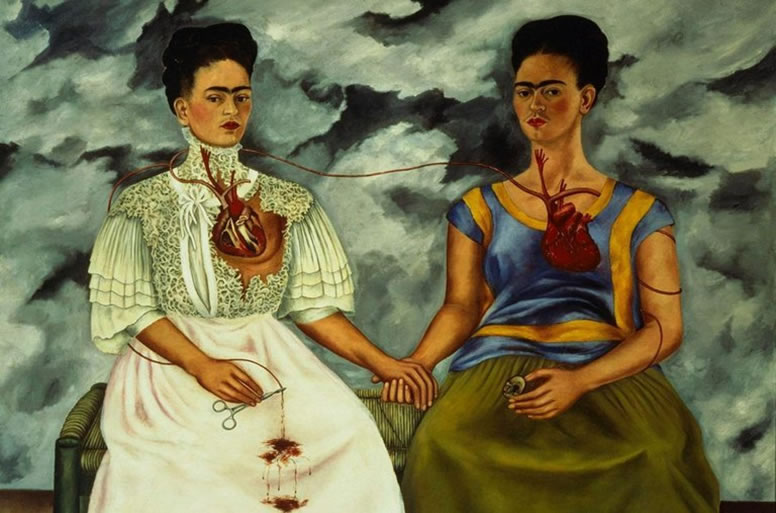
There are others who would be happy to lead you across the stream of your life, and you can take the same paths that others have created before you. But in following others, you lose the chance to be yourself. You may be afraid to follow your true heart on a path that is yours alone; you may want to know where it will take you (somewhere good, somewhere bad?). But Nietzsche encourages you simply to take your path. This is what it is to be a true human being as Nietzsche sees it: to be original and creative and honest in your own self-fashioning. This is how a true artist lives.
Some key ideas from elsewhere in Nietzsche’s philosophy
Nietzsche is a philosopher in some ways well suited to 21th century readers, as he mostly wrote books as series of "aphorisms" - short passages (sometimes almost tweets) that looked closely at one idea, tried to get to the bottom of it, usually turned it inside out, and then moved on. He frequently seems contradictory, as his books record his own "dialectical" thought processes rather than a coherent system. You may like one thing he says and hate the next one. He is radical and rude, by the standards of his day at least. He never stops thinking, and in my opinion he was better at taking the conventional assumptions people live by apart than in coming up with credible alternative ideals of his own. His thought is often "mercurial." It's a wild ride, at least by 19th century standards.
The excerpts selected for study in GNED 101 almost make him seem like a motivational speaker, which is pretty ironic if you know the rest of his work. But he certainly is trying to motivate you. He wants you to wake up and live. His bourgeois [upper middle class] Victorian contemporaries, he felt, were trapped in pointless and outmoded conventions, living dreary lives of unexamined conformity. They lived in fear and most of the fear was simply of being different or being wrong or not being liked, social judgment. Does he still have something to say to us, 150 years later?
Some of Nietzsche’s most influential or controversial ideas are useful to give context to the excerpts we are reading. (And it is useful to know about them at certain kinds of cocktail parties, so read on! ;-).
The Eternal Recurrence
In his book The Gay Science (which has nothing to do with homosexuality, although the idea of “coming out” is very consistent with what Nietzsche is urging all of us to do), Nietzsche asked his readers to imagine that a “demon” visited you and revealed to you that you will repeat the life you are living now in all its details, over and over again (without knowing that you have lived it before), for all eternity:
This life as you now live it and have lived it, you will have to live once more and innumerable times more; and there will be nothing new in it, but every pain and every joy and every thought and sigh and everything unutterably small or great in your life will have to return to you, all in the same succession and sequence—even this spider and this moonlight between the trees, and even this moment and I myself. The eternal hourglass of existence is turned upside down again and again, and you with it, speck of dust! (The Gay Science, 341)
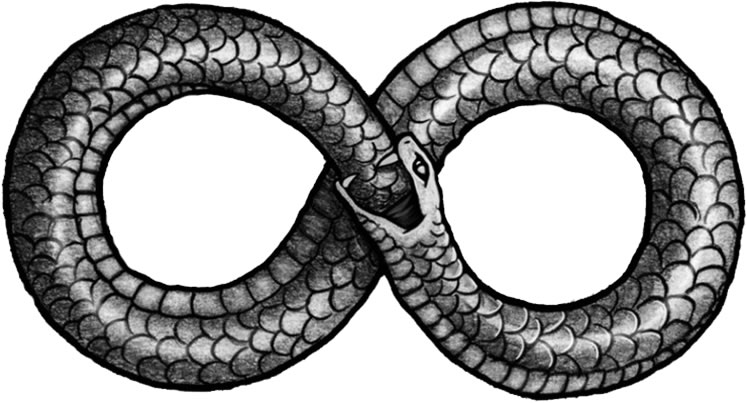
Nietzsche asks you if you learned this was the case, whether you would rejoice to think of your life exactly as you are living it repeated indefinitely through all eternity. Or would you put your head in your hands and weep?
By implication, if you would feel miserable at this thought, Nietzsche wants you to ask yourself why you are living the life you are now living. It is a thought experiment intended to make you question your life more deeply and whether it is really the life you want to live.
Herd Mentality
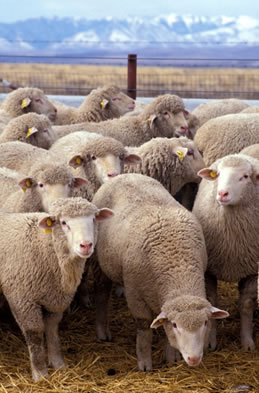
Nietzsche believed that human beings are inclined to be herd animals, like cows or sheep, and that our herd instincts lead most of us to live lives of conformity. As he said in the first passage quoted above, we are lazy and afraid. It is easier and more comforting to go along with everyone else, even if by doing so we sacrifice what makes us unique and interesting.
We’re lazy sheep. And we’re afraid. Afraid to be ourselves, afraid to be different, afraid to be alone, afraid to be wrong, afraid to be true to what deep down we know to be our truth. Afraid to live, in this world, this life. Afraid of the unknown.
As Nietzsche sees it, in the modern civilized world, we’ve been conditioned to be afraid of our true individuality and uniqueness by what we often refer to as “society.”
But what do we actually mean by “society”? That is a vague way we often refer to the forces we feel are pressuring us to conform. But who is “society” really? Real people, just like us, are the ones conditioning us to conform. They are imposing their fears of change or difference or standing out on us. It starts with our parents or early caregivers, and our families. In Nietzsche’s day, the Church (Christian for most Europeans) was also a huge force, and Nietzsche spent a lot of time trying to expose the tactics of fear that helped the Church push people to deny their uniqueness. Next come our educators. [blush] Teachers might seem powerless and irrelevant as we mature, but in our early years they do tend to be major forces in the “societal” project of conformity. Our friends and peers encourage conformity, as do our various cultures and subcultures (religious, ethnic, gender, social and economic class-related, etc). Finally - and this was less obvious and powerful in Nietzsche’s day, but if he were writing today this would probably take the place of religion for him – there are the media (television, radio, ads, movies, comic books, video games, etc) and now also social media.

When we talk about “society” we really mean those people, cultural norms, and mass media that try to tell us why we should be like they say and not be ourselves.
We join the herd because it is easier than being ourselves, affirming our true uniqueness.
But in cloaking our quirkiness in order to conform, we are actually denying reality (the reality of who we really are), and we are denying the very things that distinguish us as humans from the rest of living beings. Even the things we are most ashamed of are part of what make us interesting and what make us special, a unique being in all time and space. This is how we could enrich the world, with our individuality. And this is who we really are – or should be.
The “Superhuman”
Nietzsche sometimes spoke of the Ubermensch, usually translated as “Superman” (although the German word is not exclusively for males but refers to a generic human being). Nietzsche said different things at different times about the “Superhuman,” but he often meant by it a currently unknowable human being of the future, as unlike the people of the present day as the people of the present day are unlike Stone Age humans, or even pre-human primates.
Here’s a bit of what he has his character Zarathustra say in his most poetic (and most pompous) book:
The human being is something that shall be overcome. What have you done to overcome it? … All creatures so far have created something that went beyond themselves; and do you want to be the ebb of this great flood, and even revert to a more animal state rather than overcome the human state? What is the ape to a human being? A laughingstock or painful embarrassment. And the human of today shall be that to the superhuman: a laughingstock or painful embarrassment.
….
Humanity is a rope, tied between beast and superhuman—a rope over an abyss … what is great in humans is that they are a bridge and not an end. (Thus Spake Zarathustra)
So Nietzsche wants you to imagine how the human beings of the future will look back on those of the present day, and we will seem as sad or laughable to them as cavemen seem to us. Being a conformist does nothing to move humanity forward in our evolution toward a better, or "higher," being.
The conformist of the present day is therefore the “enemy” of the superhuman of the future, because the conformist is a form of human being that is keeping humanity stagnant, or has even degenerated, become complacent, lost all connection with higher ideals, thinks only of the present and easy comfort, has no big dreams, doesn’t want to change the world, tries to fit in and squeak by. The conformist lives by principles such as “think small” or “keep your head down” or “fit in.” This does nothing to move humanity forward. Only non-conformists can provide new attitudes and insights to move us forward.
Nietzsche scorns those who want to live like this. They are inferior humans, dragging us down as a species.
And even if we couldn’t care less about advancing humanity or contributing to a more “superhuman” future, Nietzsche warns us that we are doing ourselves a disservice right now by living a conformist life, rather than a creative and original one unique to our true nature. Here is a bit more of our assigned reading:
But even if the future gave us no cause for hope, the fact of our existing at all in this here-and-now must be the strongest incentive to us to live according to our own laws and standards: the inexplicable fact that we live precisely today, when we had all infinite time in which to come into existence, that we possess only a shortlived today in which to demonstrate why and to what purpose we came into existence now and at no other time. We are responsible to ourselves for our own existence; consequently we want to be the true helmsman of this existence and refuse to allow our existence to resemble a mindless act of chance. One has to take a somewhat bold and dangerous approach with this existence: especially since, whatever happens, we are going to lose it.
Even if our existence actually is “a mindless act of chance,” most of us don’t like to think of it that way. We want our existence to be meaningful and important. Hiding among the herd does nothing to make it so. Nietzsche thinks we need to live our lives in a more daring way, since they are the only lives we will ever have and we are bound to lose them eventually (die) whether we toe the line or break away from it.
Creature and Creator
In the human being, creature and creator are united: in humans there is material, debris, abundance, clay, crap, nonsense, chaos; but in humans there is also creator, maker, hammer-hardness, spectator-god and seventh day – do you understand this opposition? (Beyond Good and Evil, 225)
Given Nietzsche's poetic, 19th century language, it is unlikely that you do immediately understand what he is saying here. I think he is saying that each human being is a unique mix of "creature" (already determined being) and "creator" (free agent of innovation and change). On the one hand, we are creatures, like the other animals, determined by our biology and our upbringing and limited by them (creature). But unlike the other creatures of the earth, each human being is also capable of immense creativity and original thought and action (creator).
Here is how I would paraphrase the passage in what might be slightly clearer language:
In the human being, there is something that has already been created and also an active creator. Every human being is full of raw material, “baggage,” unlimited stuff, junk, mixed-up mess. But every human is also capable of creating and crafting something out of all that, shaping all that stuff into something unique, and then sitting back and admiring their creation. Do you understand how you have both of these aspects?
In other words, you’re dealt a hand in life (you’re born a man or a woman (mostly), black or white (or whatever), into a poor family or a rich one, in Canada or in China, etc; you’re raised in a certain way and this also shapes you – you are a “creature”). But what you do with the hand you've been dealt is up to you (you can be a creator with yourself and the hand you've been dealt – there are all kinds of ways for you to play - or play with - the cards you are holding.
I often think of it this way: in a sense, you're a mess. It's like someone backed up a dump truck and dumped a big pile of garbage on the front lawn. That's you. What can you do with a pile of garbage on your front lawn?
Some people would try to clean it up. Some might throw a tarp over it and try to hide it. Some would see what could be salvaged from the junk and still be used. Some in desperation might just set fire to the whole thing. These are all possible ways of dealing with the pile of junk that is you.
What would an artist do with the pile of junk? The answer is what I think Nietzsche is recommending you do with your life.
One last excerpt from the assigned reading:
One thing is necessary. — To “give style” to one’s character— a great and rare art! It is practiced by those who survey all the strengths and weaknesses of their nature and then fit them into an artistic plan until every one of them appears as art and sense, and even weaknesses delight the eye.
This passage has come to have more significance for me personally as I have aged. When I was young. I assumed I was going to be kind of a big deal, and while I wouldn't say I have been exactly "lazy" in life, I do think I have been afraid, and that has been part of what has kept me from being a big deal. But now, as I start to see a shape to my life, I can see how, given what a fearful creature all the bad parenting I received was bound to create, maybe I have actually been quite courageous and creative, under the circumstances.
This could be seen, cynically, as a kind of "rewriting" your life to include your most shameful and unsatisfying moments and characteristics as more positive or essential features of the beautiful and interesting masterpiece of you as a whole. Yes! I think it's consistent with what Nietzsche is saying here. You must use your imagination and your love to create a you that is beautiful or interesting or aesthetically satisfying, "warts and all." That's what art does with reality; that's what you should do with yourself.
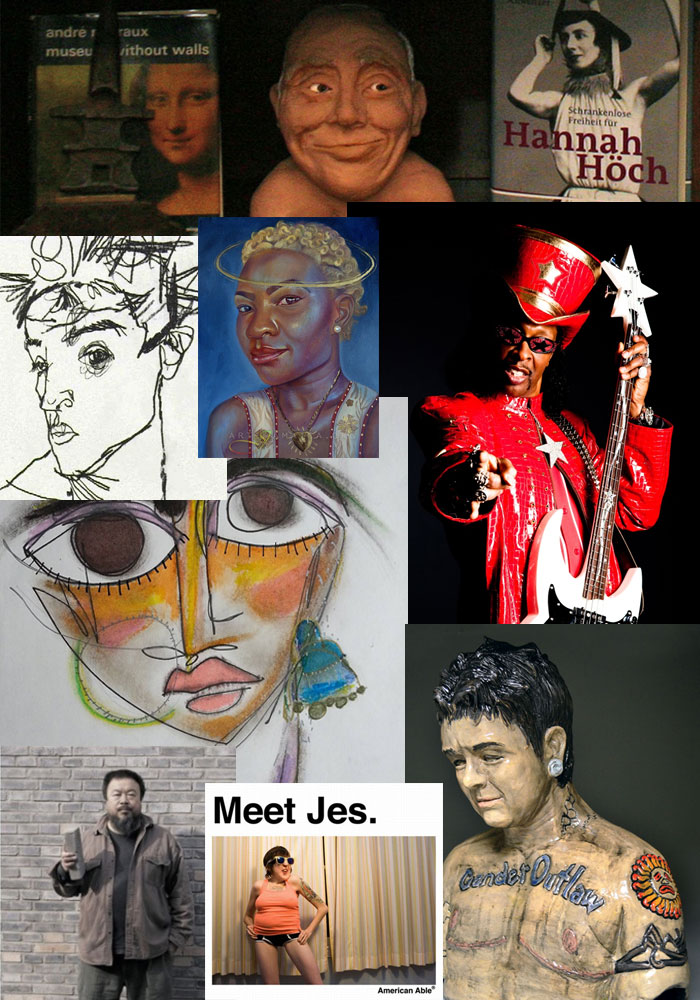
For Nietzsche, each human being is a work of art. Some are terribly boring works, “factory products.” Some are evil, immoral works (but they may still be colourful ones!); the ones that stand out move evolution forward, toward something "higher" than our current state. But all of us are "works of art," experiments in creative evolution.
Nietzsche considers all life on earth and indeed the whole universe to be a sort of “experiment” and a giant work of art, and he considers each of us individually to be experimental works of art, each unique, each potentially beautiful and interesting. He encourages us to embrace the freedom we have discovered - now that many of us don't have god or the authorities of the past to keep us in line - and to be creative and true to ourselves in our self-expression. This is what truly great artists do, as Nietzsche sees them. Be yourself. Turn yourself to 11. Bring forward the things that make you different.
Existentialism
Last week I mentioned that all three of the thinkers we are studying in this unit can be considered humanists. The assumptions of Existentialism would probably not have seemed strange to any of them. None of them looked to God for the answers, but instead assumed that we are alone in the universe, we only live once, and we have to figure things out for ourselves.
Nietzsche's tried to take a rather joyous attitude to this freedom, but let's start on what most people still see as a grim note. Often people who have heard about Nietzsche before this class know him mainly for one of his most famous pronouncements.
God is dead.
What he meant by this, mainly I think, is that in the "modern" world (even back in the 1870s and 1880s when he was writing) people don't really believe in God anymore. Not in the way they had, for instance, during the Middle Ages, when virtually everyone in Europe was a Christian and almost everyone was illiterate and looked to priests to tell them what was true and right. In the modern world, we know that there are many different religions throughout the world, and dozens more that have gone dead throughout history. We also have science, which has suggested to us our true insignificance in the universe, and forced most of us to recognize that we are vulnerable animals, whatever else might be going on.
Nevertheless, it was shocking to Nietzsche's readers in his day, and still may be shocking to you today to hear something so blasphemous and unequivocal. People who did come to accept what he had to say usually found it deeply disheartening.
But Nietzsche himself insisted that it was good news, or at least there was a positive side. We are free, and we ourselves are as close to a god as anybody is ever going to get. Though we can't hope for eternal life, we don't have to fear eternal punishment. Nothing is forbidden. We are the ones who decide what is right and wrong.
In his belief that we can't look to God for guidance, Nietzsche was an Existentialist before there was a name for it, and he inspired many of the thinkers of the 20th century who made Existentialism into a kind of a "religion" for those who are atheists or agnostics.
The Existentialist attitude toward life starts from the assumption that there is only this life and the purpose of life is found in our own process of living. The philosophy really came of age after World War II (which ended in 1945). The horrors of the war, the Nazi holocaust and the creation of the Atomic Bomb led many thinking and feeling people to the conclusion that "civilized" human beings are given to great evil, and to the recognition that we are capable of destroying ourselves. There was no sign of God coming to the rescue. They reasoned that we human beings have to do what we can ourselves if we care about our survival and creating a more just and liveable world. This is more or less the way I personally tend to think, as you may already have noticed. I think I'm a kind of Existentialist. The thinker we will look at next week, Viktor Frankl, actually lived through the Nazi holocaust, and he came out of it an Existentialist, I would say.

Existentialism starts from the assumption that you must find the will to live and the purpose of your existentence in yourself, despite the depressing reality that life is probably ultimately meaningless and we will all eventually disappear forever. Finding this positive will to live in yourself is a kind of religious experience for some. The famous existentialist Albert Camus, for instance, wrote "In the midst of winter, I found there was, within me, an invincible summer."
Two of the most influential Existentialists were Simone de Beauvoir and her life partner Jean-Paul Sartre. De Beauvoir was a feminist before it became a movement and the focus of her and Sartre is for the individual to take responsibility for the world. If humans can be wicked and destructive, and no one else is looking out for us, we must solve our problems for ourselves. We're on our own here.
We are absolutely free (at least in terms of the past and God), but for de Beauvoir and Sartre that should lead to a sense of responsibility, not despair or libertinism: the world wasn't created by God; you and I are creating it right now. As de Beauvoir once put it, "Each of us is responsible for everything and to every human being."
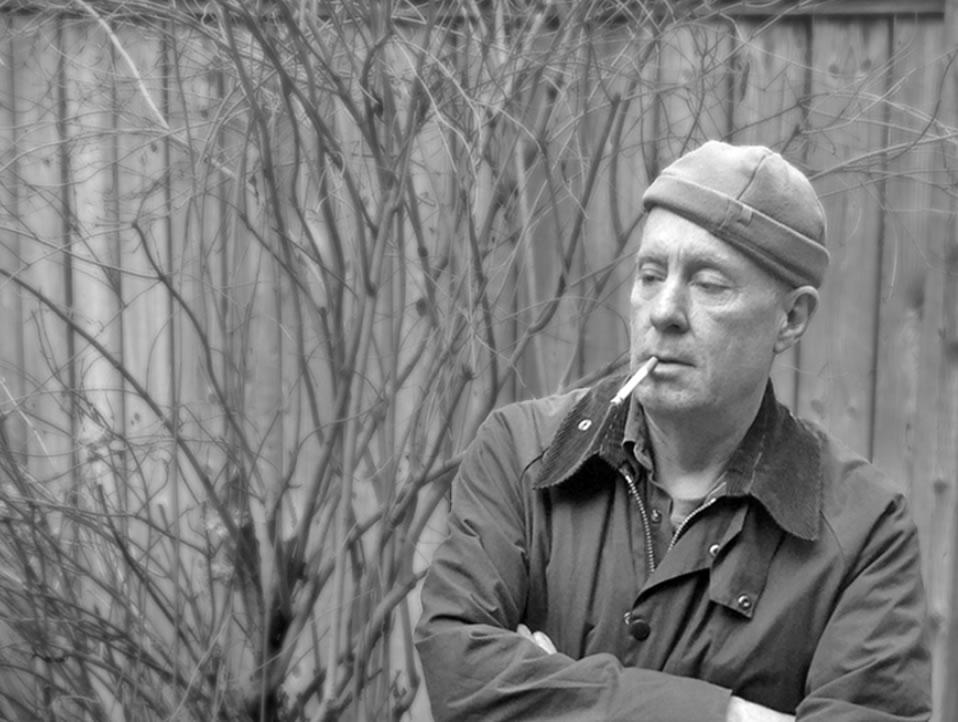
Working my Existentialist look a few years ago. I only smoke to keep my genuinely smoking friend Lewis company once in a while. Don't worry; like Woody Allen and Bill Clinton, I don't inhale.
You make the meaning and value your life has. You choose the world you want to live in and the meaning your life has, by your actions.
Existence precedes essence
Sartre claimed that we are what we do. We aren't just made some way and that defines us for the rest of our lives. We can choose. For instance, you might be trying to decide whether to cheat on your partner. Rather than telling you that adultery is a sin, an Existentialist would point out to you that your decision to cheat or not to cheat will shape you, the future, and the world. You are choosing the moral universe you want to live in. Do you want to live in a world where you have cheated on your partner? Do you want to be untrustworthy? Do you want a world where people are less trustworthy or more trustworthy? And so forth. We make the world, through our day to day choices. The world is still changing all the time; you will be part of that change or part of what keeps it where it is, for better or worse.
There is no absolute meaning to life; we are creating the meaning it will have.
Though he is nowhere near as heavy as de Beauvoir or Sartre, Nietzsche certainly would have agreed that we are making up the meaning of life, humanity, and ourselves as we go along.
But Nietzsche took this lightly. Because there is no God and no authoritative direction, we should try to make this life into an art project! We should try to make ourselves and the world beautiful or interesting or unique, like great art is.
How? You do you. That’s all we really can do anyway. So why make yourself a carbon copy of somebody else just because you are lazy and afraid? This is your one shot at you. You can’t know or foresee how you should or will come out. “Courage – and throw the dice!” Be adventurous with your life.
You are a unique being, and an experimental work of art. Dare to be it fully! As Nietzsche saw it, that’s the best thing you can do for yourself and for the rest of us and for the future of humanity.