PARASOCIAL/SIMULACRUM/HYPERREALITY
Be sure you understand
- Vicarious
Experienced through other people, real or fictional, by imaginative identification with them.
- Parasocial
A term for one-way imaginary "social" connections with influencers or fictional characters through media, as when someone "hangs out" with the characters in an episode of Friends, or "spends time with" a cottagecore influencer.
The replacement or supplementation of embodied social relationships with real people by imaginary communion with real and fictional shadows on a screen.
- Simulacrum
A simulacrum is a human-manufactured imitation, image or representation of a natural or handicrafted thing or experience.
Critics worry that the world is being made less real, less deep, and less alive because late capitalist human culture moves to replace real things with simulacra of things.
Jean Baudrillard thinks that the simulacrum is a useful way of referring to how humans increasingly engage with images that are a copy of a copy of something that never existed in reality. - Enshittification
Cory Doctorow's word for the claim that media platforms have been degraded by the possibilities and values of 21st century technocrat capitalist culture. Sometimes people extend this to talk about the effects of hypercapitalist models and ideals on other aspects of our social and work systems, turning all experiences, all “users,” and all human goods and "human resources" into markets and commodities (products) and turning all aspects of life into a marketing opportunity, a micro-transaction, a chance to collect information about you for control and marketing, and a tool to get your attention and colonize your consciousness at any cost. - Hyperreality
Jean Baudrillard's term to describe how representation-heavy our "reality" has become. The typical person’s “reality” is a mix of lived experience and media, and the media itself is a confusing mix of images: photographic and “documentary,” invented and fictional, doctored, edited, packaged, all looking much the same ("real").
Much of what we treat as real is actually a mediated simulation, and we living non-simulations try to recreate the images we see, even though they are often not true to lived realities, we try to embody media simulations.
This week's lesson gets seriously theoretical and metaphysical on your ass, by introducing some of the ways late 20th- and early 21st-century thinkers have been looking at the development of our cyborg selves thanks to the combination of more sophisticated media and technology, more insidious forms of capitalist colonization of our lives, and more virtual and "hyperreal" forms of reality for people to "live" in.
Parasocial "relationships" and vicarious "experience"
Vicarious experience means watching or hearing about someone else doing something and somehow imaginatively identifying with them and getting some of the effects of doing it oneself, even though one isn't really doing anything (except sitting in a movie theatre, lying on a couch, or staring into a phone on a bus). It's strange, if you think about it, that people can lie on the couch watching a crime drama and get stimulated through some kind of vicarious identification with onscreen lovers, adventurers, action figures.
This vicarious identification is superbly satirized in the Simpsons "couch gag" sequence "LA-Z Rider" (a take off on the old tv series where a computerized car helped David Hasselhoff solve crimes (Knight Rider, 1982-1986)). Here, a motorized couch assists a fantasized version of Homer in experiencing a Miami Vice kind of exciting, sexy, fast-paced "life."
Parasocial is term used by sociologists and psychologists to describe a one-way imaginary "social" connection with influencers or fictional characters via media, as when someone "hangs out" with the characters in an episode of Friends, or "spends time with" a cottagecore influencer. Parascocial "relationships" were hard or impossible before tv and social media, but are now quite common. The era of tv and the Internet have led to the replacement or supplementation of embodied social relationships with real people by imaginary communion with real and fictional shadows on a screen. People can get vicarious effects of socializing from these experiences of media consumption.
I like to use the example of my own mother here when explaining what parasocial relationships are. I think these experiences relate to idea that we have drifted from real life interaction to mediated consumption in interesting ways. Maybe some of them are okay, or at least "therapeutic."
My mom spent the last ten years of her life living by herself in her house in the Seattle area, and she would spend most evenings with reruns of the television show Big Bang Theory back to back on syndicated tv. The characters on the show were her "best friends," or in any case they were the "people" with whom she spent the largest amount of time near the end of her life.
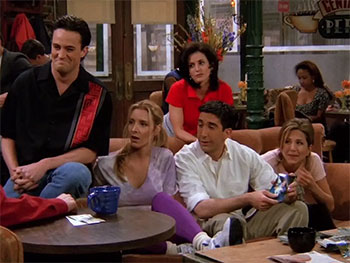
There is nothing that unusual about my mother treating fictional TV characters kind of as though they were real. Whenever someone says "Did you see what Sheldon did last night?!" they are immersed in the "fictional reality" of our modern world. Human culture is inherently like this - a mix of lived and mediated reality.
But is it possible that the greater replacement of social life by The Spectacle and the greater choice of virtual realities (video games, for instance) make our lives less really real or really alive all the time? And does that matter or not? What do you think?
Hanging out with some Friends
My mother watched Big Bang Theory because she wanted the illusion, a simulation, of some human company in the house with her, and she liked the company of those characters. It can be "therapeutic" for many people, as long as they don't become obsessed or put themselves in a position to be exploited (by an influencer, say) or a stalker (you can't stalk Sheldon, but you could stalk Mr Beast). Human beings can apparently get some of the same benefits they get from real live social interaction through the parasocial experience of watching Friends, for instance. Of course, they are being "social" with non-real (fictional) people and the "interaction" is not really interaction. It is one-way, and though you have been affected by these fictional characters from the 1990s, the fictional characters can in no way be influenced or changed by you: they are recorded images, they were fictional anyway, they can't hear you or see you. Can we really call such interactions "social," or even "interactions"?
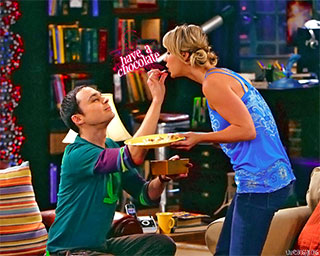
Isn't this another of our semi-real spectator activities? We can get real information about human interaction or understand the world differently from watching sitcoms, of course. Or can we? The characters are realistic. Or are they? Do we care? Does this make us more real in the world? Does that matter?
It seems that most of us don't care. It's not so much that we don't know that Sheldon or Ross, Rachel, and so forth are fictional characters and not real people, as that we don't seem to care about this distinction as much as we might. We are used to spending a large amount of our time with non-real media projections, images on screens that look something like people. And they become a big part of our reality. Even if we "know they aren't real." (Do we understand that, though? Really?)
With the Internet we now know "real people" (not fictional characters (?)) that we also experience frequently through the media (our friends on Instagram, for example, and people we have never met in real life whom we have friended or followed). Getting our "reality" in these mediated ways might make some of us (all of us?) less clear on the difference between (lived, embodied) reality and (spectated, framed/fictionalized/fictional, two-dimensional) media. And as the simulation comes to look more like reality itself (only "better"), or the simulation's "reality" comes to replace physical embodied reality for us more and more of the time, we seem to be less concerned about whether the things we love, the "people" with whom we get emotionally involved, or the situations on which we spend our time and energy are "real" in the old physical, embodied, non-screened sense or not.
Is that okay? For us? For the rest of the world on whom we have an impact?
Are influencers real people and are their lives real lives?
With social media, more and more parasocial relationships can develop with "real" people (as opposed to fictional characters) we've never met, though these "real people" may have been doing their best to simulate the copies of real people simulated on fictional television or to seem like the non-fictional people who have a highly fictionalized representation there, such as celebrities. Do we remember (or care) how unreal all this really is? Maybe.
The parasocial relationships one has with Internet micro-celebrities or "influencers" can sometimes move into more genuinely interpersonal social relationships, when you contact them and they actually respond to your comments, send you an email, or mention you in a blog or a podcast or YouTube channel or TikTok. But there is still always a screen between us, a representation of an absent reality - editing, framing, simulation.
Reality tv, porn, lifestyle influencers. Real-life people as Spectacle. Real people as “entertainment products.” These are idealized and edited versions of life and of these people, so "not real" in some important sense. But at the same time they also really are those people at least in some sense and really are doing those things, even if they are doing them in front of a camera, and are thus also acting. So in a sense what we see is both real and simulated. Consumers of their media may complain that these images of real people are "unrealistic," but they continue to consume the images, partly because they aren't realistic, but rather consumable fantasy.
INFLUENCERS. The basic idea is that the person represented in the video or images is a creation or presentation of the person behind the images, who is both a performer and a media producer, with all of the fictionalizing, and branding, etc that were part of 20th century manufactured media - and maybe there's nothing wrong with that, as long as you understand that it's media and not reality. But do we KNOW this deeply? Can we know it?
In 2021, French YouTube vlogger Alice Cappelle considered lifestyle vlogging as a "deal" similar to that between audience and creator in a movie theatre. We have agreed to meet in an unreal but emotionally satisfying "collision." She suggests that these hyperreal, parasocial kinds of media should be seen more as therapeutic art than spontaneous social interactions - or rather, she concludes that social interactions themselves may not revolve around authenticity so much as around this kind of emotional therapy and imaginary bonding:
... the exchange between a viewer and a creator is similar [to] that of a patient and a therapist, except that the experience and stories shared by the vloggers are as therapeutic for the audience as it is for themselves. [This] brings us back to the initial metaphor of the "deal": a movie, a book, a vlog is a place of collision of two imaginaries. The bond the creator and the viewer share is not based on authenticity, but on the emotion produced, crafted by the vlogger. In the end there is no such thing as authenticity. Just look for a second at the friendships you have in real life. We constantly edit our thoughts to make them fit social norms, social codes - to appear friendly, intellectual, intimidating. We all lie sometimes. and we behave differently depending on the people we're surrounded with at that precise moment. The result is that we are always unsure of what our true self is, which version of our self is the most sincere. For me, watching vlogs and bonding with vloggers has been a way to just escape for a bit, to discover a bit more about myself, and to project myself as well. It really feels empowering. (Cappelle 2021)
Of course Cappelle is a vlogger herself; she knows well the imaginary power of this kind of "interaction," and relies on it at least in part for her living.
Many viewers, however, rather than treating the vlogs as self-extending fantasy/therapy/escape the way Capelle thinks we do, instead feel disempowered when their own real lives compare badly to the lives portrayed by their social media "cohort." We think that "this is what our life could be!" but never see the tedious aspects of the lives, the work that goes into that 20 minutes, the times they got their makeup wrong and had to re-shoot, the stress and burnout. The ways in which, even if they are being spontaneous and real, they are also always acting for the camera.
When the rest of us treat social media personas as our parasocial circle, we may well feel supremely inadequate, like the fat kid outside the high school clique (that was me!). If you think high school is a bitch, wait till you get on Insta and Tik Tok and Twerk (or whatever it's called). Now you're trying to fit in with semi-professional influencers who spend all their energy in presenting a larger-than-life identity. People didn't worry quite as much in the past, I suspect, (though some did) about not living up to the cuteness and wittiness of the characters on Friends or even not being able to keep up with the Kardashians, because on some level television was still acknowledged as not real life, fictional, staged, scripted, out there, made by giant corporations in Hollywood dreamland - not anything that could be confused with socializing with real people. Chapelle encourages us to see vlogs today in the same way, and not to worry about the parasocial escape some people are replacing embodied friendships with. Escape is therapeutic.
Social media is only sort of social. It is not social in the sense of being interactive spontaneous engagement with others most of the time. And much of it is not even about connecting to other individuals or groups, actually being social. What the major social media platforms tend to provide is a mediated mix of everything: social connection with people we know, glimpses of other people's reality and fantasy, news, political views, corporate media, edited photos, ads, absurdist videos, fiction, heartfelt activism, whacky escapism, oversharing, genuine communication, lies, fake news, and stuff your real-life friends really wanted to share with you. It is television plus us - exponentially. All presented in much the same way. No wonder we don't know what is real any more.
This partly also ties in with our continued television era readiness to accept any media as escapist entertainment. But now we are socializing and engaging in political action and communicating with our friends and families and strangers through our entertainment media. Media has thus become even more of a mix of serious, heartfelt, ironic, duplicitous, authentic, personal, shared, fabricated, manicured, raw, funny, heartbreaking, real and fake media, just like tv was only much more so. Does this make it more like life, or an even greater seduction away from being alive fully in the world?
Simulacra and hyperreality
In the late 20th century, some theories about how media consumption has come to supplement - and for some people replace - lived experience became prominent. Largely these formed around the work of the French philosopher Jean Baudrillard. Baudrillard was influenced by Guy Debord and the Situationists, and much of his work can be seen as an unpacking of the Situationist slogan "All that once was directly lived has become mere representation."
A simulacrum is a human-manufactured imitation, image or representation of a natural or handicrafted thing. It is an imitation, a simulation, an artificial replacement for something organic. Modern industrialized consumer societies are full of simulacra (the plural of simulacrum): plastic fruit (in both the literal and figurative sense), plastic flowers, artifially flavoured foods, imitation leather, manufactured wood veneer, etc. Baudrillard argued that the technologies of late capitalist societies offered people simulacra increasingly in place of real things. He talked about the illusionary nature of American experience in particular: going to Disneyland to see the Matterhorn, or the near lifesize models of the Eiffel Tower and Venetian canals in Las Vegas. Television presented a fantasy representation of life that was rife with simulacra, and as the 20th century came to an end, the rise in Reality TV shows was noteworthy. Reality TV shows are both "real" (because people perform themselves) and unreal (because people perform themselves).
Many worriers worry that our electronic media are a giant, growing simulacrum gradually replacing embodied physical and social life and presence in reality.
Nostalgia for the real
It's not impossible that American mass-produced culture has been doing its best to manufacture replacements for real things and experiences. Many people feel nostalgia for a past that was richer and more alive. Here are some excerpts from a YouTube commentator talking about this side-effect of advanced technology and capitalism:
In these clips from her 2026 video "The Great Enshittification: You're Not Imagining It," Maledicta (Marina Kosova) complains that her belief that human existence is getting degraded by technology and capitalism is an example of the "enshittification" that Cory Doctorow sees operating in 21st century media platforms.
Doctorow suggests that the Internet has been degraded from what it was only a couple of decades ago. In particular, our social media platforms have become overrun with ads, algorithmic manipulation, paywalls and microtransactions, and other obstacles to the "socializing" we can do there. By turning all experiences, all “users,” and all human goods into commodities (products) and turning all aspects of life into a marketing opportunity, a chance to collect information about you for control and marketing, and a tool to get and keep your attention at any cost the technocrat billionaires are runining what was once an amazing and beautiful human innovation: the Internet. He uses the term "entshittification" to the inevitable degradation of good and real things when capitalists get their hands on them.
When I was young old people would sometimes complain, as Maledicta says in the video, that fruit tasted better in the past. We young people often dismissed these claims as romanticized memories of a time when the old people had been happier simply because they had been younger. But of course things had probably been simpler and more straightforward in the past and had become more "enshittified" in certain ways as they grew older. Young people in the 2000s and 2010s were often nostalgic for the 1980s, when The Future still seemed to have a future, and look cool and promising. Watching Friends reruns might be an example of 21st century nostalgia for a time before smartphones on the kinds of friends one has on social media.
Like many people before and after him, Baudrillard was nostalgic for a past where the real had supposedly seemed realler. Did he just miss his youth, or had he landed on an important byproduct of technological and capitalistic progress?
Hyperreality
Baudrillard famously started using the word hyperreality to refer to way our sense of reality has been colonized by the simulacra of reality in our every-increasing consumption of mass media (he died before social media had really taken off, but he would probably have argued that these platforms are hyperreal simulacra of embodied and living social activity).
To talk of hyperreality is to recognize that the typical person’s “reality” is a mix of lived experience and media consumption, and that the media itself is a confusing mix of different reflections of reality: photographic and “documentary” images; invented and fictional images; doctored, edited, and packaged images; downright "fake" images - all looking much the same: “real.”
Much of what we treat as real, the basis of our sense of reality, is actually a mediated simulation. And Baudrillard also pointed out that we (living non-simulations) take the simulacra as our models: we try to recreate the images we see, even though they are often not true to lived realities; we consumers of video and photographic media try to embody and perform media simulations. We are copying not real other people, but idealized and stylized media simulacra.
Hyperreality includes a number of suggestions about our relationship to reality:
- The idea that our conceptions of reality are a mix of lived perceptions and consumed representations.
- The idea that our media are also a confusing mix of fictional, falsified, and supposedly true representations, all of which look “real.”
- The increasing importance of these representations to our sense of what is real, and our increasing tendency to recreate representations that are not based on reality but on images that are common in the media.
- Our gradual abandonment of lived experience as “reality.”
Ever deepening hyperreality?
At one point Baudrillard proposed four stages of imaginary/symbolic representation – representation turning into what he liked to call simulation – in human culture. It may be helpful to think of these stages in very basic terms as following upon one another from the prehistoric period up to the present.
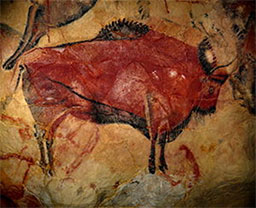
Before there was human culture and language and representation, presumably, there was a bison there in reality (for example). But we can't talk about or understand the bison except in representation. If the bison is trampling you, maybe that's reality. If you're eating the bison, that's reality. But your story about the bison, your ideas about the bison, your image of the bison, your dreams and fears about the bison – those are always representation, and the bison itself is no longer real (physically present, trampling you, or being eaten).
Let's take a brief comic strip view of Baudrillard's stages of human development, as an evolution of simulation and mediation. (And distortion?)
 Stage One
Originally, when we copied something, it was a copy of a "real" original. We painted a bison on a cave wall – it represented and reminded us of a real bison, which we would like to hunt down and eat (presumably – I don't actually know why cave people painted bisons on the walls). We probably agreed that this "bison" referred to something in the real world, though it was actually just a composition of colours on a cave wall.
 Stage Two
As the world progressed, we started creating images and symbols that were not faithful copies of reality, but which still hinted at something "real" in our fantasies. Nobody has a penis that big, but penises do loom very large in some of our imaginations, as Freud and others have shown. The image points to, though it perverts, a "reality."
Stage Three
Next, the proliferation of imaginary symbols comes to mask the fact that what they refer to does not exist physically anywhere actual. The symbol may be only a word, since there is no physical original to copy. We have a word for God and a word for justice, but these words may not directly represent any thing that is or was actual, physical, real in the earlier sense of physically present. If we try to represent God or justice we can at best use a metaphor or something that is physical to suggest what we feel about these things. That is because they are not real in the same sense that the bison was real. Our feelings about them are real, but are they real apart from our feelings?
Stage Four
Finally, we are happy to copy and symbolize the copies and symbols themselves; there no longer needs to be an "original," a real-world referent, or a material thing or physical being that corresponds to the copy. Copies of fictions are just as easy to work with as copies of real things. We come to inhabit this world of copies without originals. That is what human culture is, to a large extent. A matrix of "real simulations" of made-up, simulated unreal images.
The TV SHOW → REALITY TV → LIFESTYLE INFLUENCER pipeline
Let's go back to the simple pleasures of parasocial media consumption to conclude.
Real-life people as Spectacle. Real people as “entertainment products.” These are idealized and edited versions of life and of these people, so "not real" in some important sense. But at the same time they also really are those people at least in some sense and they really are doing those things, even if they are doing them in front of a camera, and are thus also acting. So in a sense what we see is both real and simulated. Consumers of their media may complain that these images of real people are "unrealistic," but they continue to consume the images, partly because they aren't realistic, but rather consumable idealized fantasy.
In class, I invited discussion of pornography from this point of view. No idea if anyone took me up on it.
INFLUENCERS. The basic situation is that the person represented in the video or images is a creation or presentation of the person behind the images, who is both a performer and a media producer, with all of the fictionalizing, and branding, etc that were part of 20th century manufactured media - and maybe there's nothing wrong with that, as long as you understand that it's media and not reality. But do we KNOW this deeply? Can we know it? Are they REAL to us?
PORN. Is real sex not satisfying anymore because it is not like the "idealized" (from a crude conventional hetero male perspective) sex in the simulacra of porn? I'll leave you with that. Nothing focuses an appreciation of the idea of hyperreality and why some people find it so disturbing as well as porn does. Or at least for an old person like me, who remembers sex before porn (vaguely at least, lol).