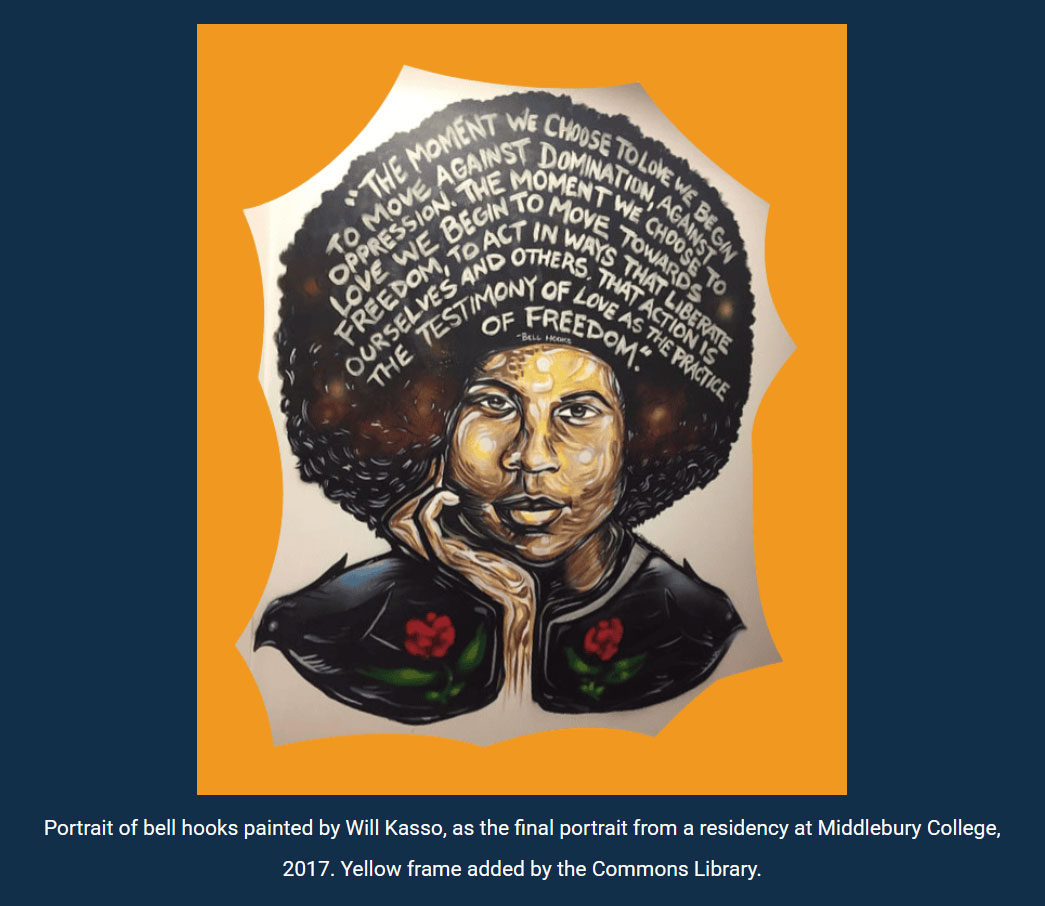
THE PUrpose of life: LOVE (bell hooks)
Be sure you understand
- hooks's definition of love taken from M. Scott Peck: “the will to extend one’s self for the purpose of nurturing one’s own or another’s spiritual growth.” hooks sees love as an act you choose, not something that happens to you.
- The predominance of the idea of choice, change, and growth in hooks's philosophy of love.
An act of love
I've looked at Epicurus who thought life should be focused on relaxed enjoyment of simple pleasure, Nietzsche, who wanted people to live their lives as an act of creation and self-creation, and Frankl, who said the fundamental human need is Meaning. For the last of our dead thinkers about the point of life, I've chosen bell hooks (1952-2021), a much loved American poet, feminist, teacher, and cultural critic. In her book from 2000, All about Love, hooks explores a life philosophy centered on the human capacity for love.
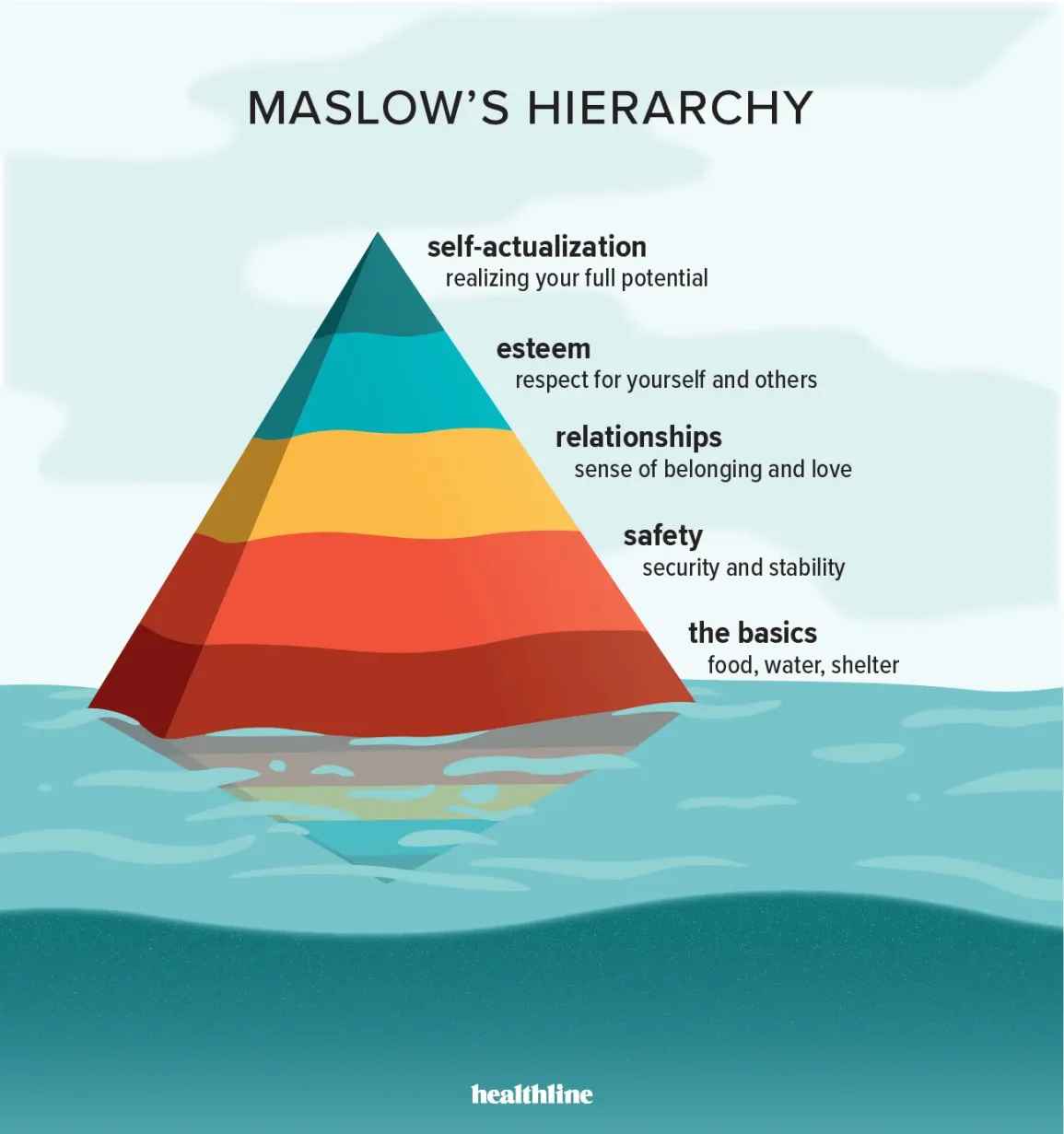
The last 25 years of the 20th century in the United States saw an explosion in books on self-help, pop psychology, and New Age mysticism. Americans were looking to improve themselves and understand themselves in a world without consistent religious underpinnings, and they were doing so in a peculiarly American, consumerist way. Rather than seeking community or meaning outside of themselves, in God, the Church, socialist solidarity, or other people, they were focused on making themselves the best version of themselves they could. The people coming of age in the late 70s and the 1980s were often referred to as The Me Generation, a self-centered movement of individuals striving for "self-actualization," the reaching of their full personal potential, the highest level in Maslow's pyramid of human needs. This is in some ways the trickle-down fallout of Existentialism, eventually stretching back to Nietzsche's insistence that every human is a unique work of art, a potential superhuman.
Superficially, hooks's All about Love could seem to fit into this somewhat narcissistic craze, but - perhaps partly because she was a woman and an African American - she can see the movement's flaws or limitations. In fact, her book is largely a dialogue with some of the most popular and influential books on self, romantic relationships, and the troubles of the sexes to come out during those final years of the 20th century. Readers coming to the book hoping it could give them practical advice on how to get a partner and be successful at love in a conventional American sense would find that what she has to offer is far more radical: a critique of the difficulty of finding love in a world that is not organized around love. The world may need to change before you can find real love!
She looks at many American ideals enshrined in the United States since the “great” old days of the 1950s: Capitalist consumerism, “Dominator culture,” patriarchal heterosexuality, even the Nuclear Family (man and woman with 2.5 children living their private lives largely in isolation from the rest of the community), and finds all of these wanting when it comes to one important human value: love. Indeed, the arrangement of social life in modern America seems to her to make love neary impossible for most people.
The definition of love
hooks begins by giving her definition of love, borrowed from the pop psychology bestseller The Road Less Travelled (1978) by M. Scott Peck. For Peck, hooks explains, love is not something that happens to you, it is an act that you choose. Love is
“the will to extend one’s self for the purpose of nurturing one’s own or another’s spiritual growth.” [quoting Peck]
“Love is as love does. Love is an act of will—namely, both an intention and an action. Will also implies choice. We do not have to love. We choose to love.” Since the choice must be made to nurture growth, this definition counters the more widely accepted assumption that we love instinctually.
There is an Existentialist quality to this definition. For Sartre, our identity is what we do. For hooks, love is an action we choose to take. If we think of various belief systems, each has a kind of drive or will that is assumed to be the most important aspect of the human being. In many religions, it would be the will to obey. In capitalism it is the will to consume, own, and control. For Plato, it was the will to truth. For Epicurus, the will to enjoy or the will to pleasure. For Nietzsche it was the will to power (growth) and the will to create. For hooks, I would say, it is
the will to love
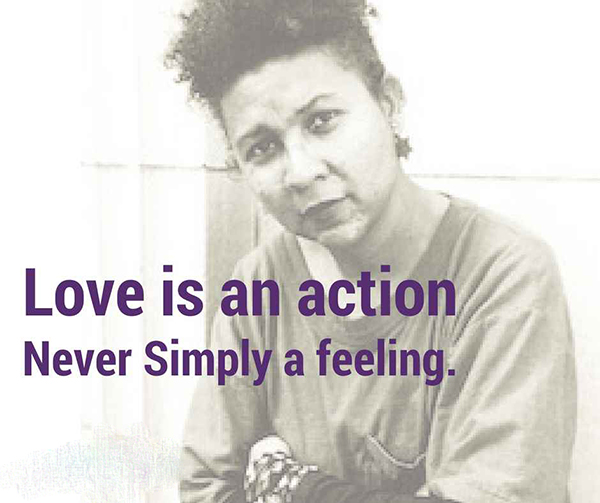
Unlike the "wills" of Epicurus and Nietzsche, and more like Frankl's "Will to Meaning," hooks's will to love is not solely about oneself. Love is something you do in relation to and with others.
hooks strongly believes that love is the same for every human being. She thus dislikes popular attempts to explain how love is different for men than it is for women, as in the bestselling Men are from Mars, Women are from Venus (1992) by relationship counsellor John Gray. For hooks, the ways men and women differ are largely culturally coded and while understanding the different attitudes men and woman may have been taught to value, culture keeps these sexual differences firmly in place, normalizes them.
It is particularly distressing that so many recent books on love continue to insist that definitions of love are unnecessary and meaningless. Or worse, the authors suggest love should mean something different to men than it does to women—that the sexes should respect and adapt to our inability to communicate since we do not share the same language. This type of literature is popular because it does not demand a change in fixed ways of thinking about gender roles, culture, or love.
For hooks, true love is not different if you are a man or a woman (or something else). All love is about choosing to act in such a way that you nurture your own and/or another person's spiritual growth.
Some folks have difficulty with Peck’s definition of love because he uses the word “spiritual.” He is referring to that dimension of our core reality where mind, body, and spirit are one. An individual does not need to be a believer in a religion to embrace the idea that there is an animating principle in the self—a life force (some of us call it soul) that when nurtured enhances our capacity to be more fully self-actualized and able to engage in communion with the world around us.
The goal is not only to be "self-actualized"; it is also "to be in communion with the world around us." This goes against the fierce isolated individualism of the United States, especially during The Me Generation. I am only six years younger than hooks. I grew up in the world she describes, and I took its individualistic narcissistic assumptions for granted most of my life. Only later in life, have I understood the limits of holding selfish selfhood above all other values and ways of being.
Justice
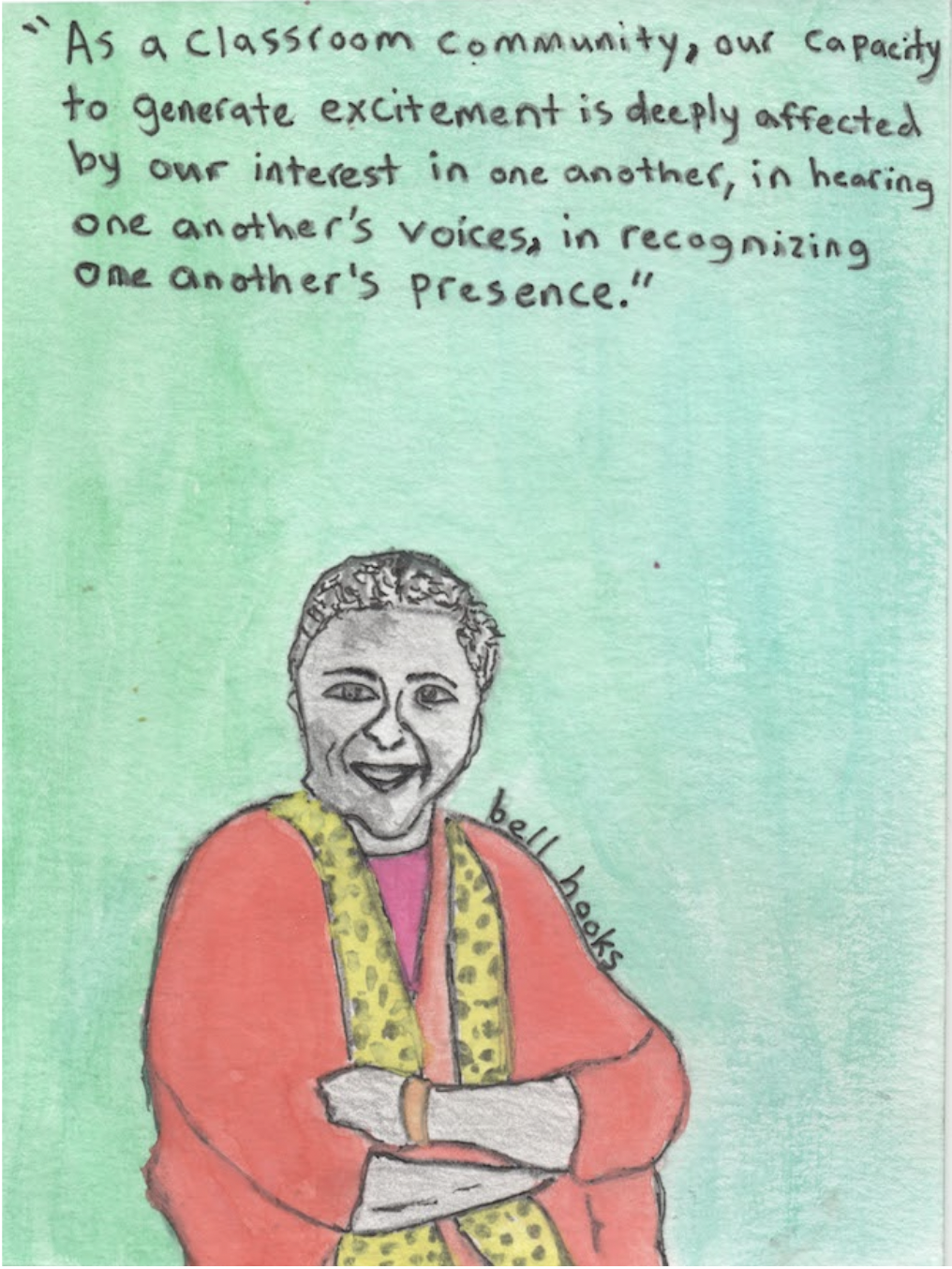
All about Love is presented as a kind of "anatomy" of love from a variety of angles, some of them quite unexpected. Justice, Honesty, Commitment, Spirituality, Values, Greed. Community. Mutuality, Romance, Loss, Healing, Destiny. Starting with Justice, one might wonder what that has to do with love, and the chapter turns out to be about the rights of children! It is amusing to imagine a narcissistic American picking up this book and hoping to find practical advice for getting a date or some action, and finding instead a constant critique of the society and culture they live in. I will discuss a few of her topics to give you a taste of how she rethinks the late-20th century attitudes toward love in North America.
Like me, hooks come from a dysfunction upbringing, and she blames the "Nuclear Family" for some of what she and others went through as children. The Nuclear Family is the model of the family that was promoted in the United States in the second half of the twentieth century, a time of a thriving middle class, many of whom could live out its individualist, consumerist, isolationist dream.
At its most basic and common The Nuclear Family is patriarchal (putting men in charge) and heterosexist (demanding one mother and one father). Typically, it involves a man - the head of the family - a woman - the mother and caregiver - and their children, living their lives largely in privacy in a single-family dwelling. hooks believes this patriarchal family model can be harmful to children (and women) and is an invitation to abuse and dysfunction. She contrasts this kind of upbringing with the extended families of the past and still common in some parts in the world, and in some American households, particularly rural ones. The presence and involvement of other family members - uncles, grandparents - and indeed of other people (friends, godparents, neighbours) in the raising of children makes for a series of "checks and balances" - other authorities and protectors for children to appeal to if one or both of their parents is abusive or unloving. She thinks that parents left to having sovereign control behind closed doors and seeing themselves as owners of their children can lead to injustice to those children.
There can be no love without justice. Until we live in a culture that not only respects but also upholds basic civil rights for children, most children will not know love. In our culture the private family dwelling is the one institutionalized sphere of power that can easily be autocratic and fascistic. As absolute rulers, parents can usually decide without any intervention what is best for their children. If children’s rights are taken away in any domestic household, they have no legal recourse. Unlike women who can organize to protest sexist domination, demanding both equal rights and justice, children can only rely on well-meaning adults to assist them if they are being exploited and oppressed in the home.
She also draws attention to the common claim made by abusers and the defenders of abuse (both of children and of women) that abuse can coexist with love. "I'm sorry I hit you, but you know I still love you."
One of the most important social myths we must debunk if we are to become a more loving culture is the one that teaches parents that abuse and neglect can coexist with love. Abuse and neglect negate love. Care and affirmation, the opposite of abuse and humiliation, are the foundation of love. No one can rightfully claim to be loving when behaving abusively. Yet parents do this all the time in our culture. Children are told that they are loved even though they are being abused.
Love is as love does, and it is our responsibility to give children love. When we love children we acknowledge by our every action that they are not property, that they have rights—that we respect and uphold their rights.
Without justice there can be no love.
Honesty
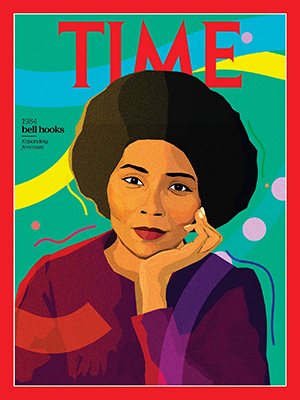
Leaving aside the fun that can be had in wearing masks and being deceptive or mysterious to attract a partner and keep them "hooked," bell hooks takes firm aim at heterosexual practices in modern America (and by extension all self-centered erotic dalliance not based on being your true self).
The heart of justice is truth telling, seeing ourselves and the world the way it is rather than the way we want it to be. In recent years sociologists and psychologists have documented the fact that we live in a nation where people are lying more and more each day.
….
Patriarchy tells us daily through movies, television, and magazines that men of power can do whatever they want, that it’s this freedom that makes them men. The message given males is that to be honest is to be “soft.” The ability to be dishonest and indifferent to the consequences makes a male hard, separates the men from the boys.
hooks often seems to target men in particular, but she is actually full of compassion for men, as she feels that we heterosexual men are often as much a victim of "the patriarchy" and its lies about humanity as women are. She insists that even the most callous and seemingly macho men secretly want love just as much as women do, and that the culture of patriarchal "mandatory heterosexuality" keeps us from attaining that love by telling us we must hide and fear our needs, vulnerabilities, and real longings.
Regardless of the intensity of the male masquerade, inwardly many men see themselves as the victims of lovelessness. Like everyone, they learned as children to believe that love would be present in their lives. Although so many boys are taught to behave as though love does not matter, in their hearts they yearn for it. That yearning does not go away simply because they become men. Lying, as one form of acting out, is a way they articulate ongoing rage at the failure of love’s promise. To embrace patriarchy, they must actively surrender the longing to love.
She critiques what has come to be called "homosocial behaviour" - male bonding and the exlusion of women. Quoting from another pop psychology book, by the male "radical feminist" John Stoltenberg, she suggests men's readiness to sacrifice their authenticity and that of women for the sake of the attention and respect of other men is an anti-love strategy that has chosen power over love, and men over our shared humanity.
“… Learning to live as a man of conscience means deciding that your loyalty to the people whom you love is always more important than whatever lingering loyalty you may sometimes feel to other men’s judgment on your manhood.” When men and women are loyal to ourselves and others, when we love justice, we understand fully the myriad ways in which lying diminishes and erodes the possibility of meaningful, caring connection, that it stands in the way of love.
Aspects of the modern isolationist, narcissist, dominator-capitalist worldview lead both men and women to be dishonest, and suggest that there is no way out of a "war between the sexes" (and that "all's fair in love and war").
Men create a false mask of their self-sufficiency and women play up to and manipulate that persona without being honest about their own needs and wants.
Women are often comfortable lying to men in order to manipulate them to give us things we feel we want or deserve. We may lie to bolster a male’s self-esteem. These lies may take the form of pretending to feel emotions we do not feel to pretending levels of emotional vulnerability and neediness that are false.
At it's worst, both men and women are subconsciously convinced they need to trick the other into giving them what they want. This can lead each to very serious breaches in honesty.
When I longed to have a baby and my male partner at the time was not ready, I was stunned by the number of women who encouraged me to disregard his feelings, to go ahead without telling him. They felt it was fine to deny a child the right to be desired by both female and male biological parents.
I personally know at least one woman who did just this. Needless to say, it is selfish and unloving toward both the man and the child she will give birth to. The culture of America, however, has made honesty and fair-dealing seem like weaknesses or impossible ideals if you want to get what you want.
In today’s world we are taught to fear the truth, to believe it always hurts. We are encouraged to see honest people as naive, as potential losers. Bombarded with cultural propaganda ready to instill in all of us the notion that lies are more important, that truth does not matter, we are all potential victims. Consumer culture in particular encourages lies. Advertising is one of the cultural mediums that has most sanctioned lying. Keeping people in a constant state of lack, in perpetual desire, strengthens the marketplace economy. Lovelessness is a boon to consumerism. And lies strengthen the world of predatory advertising. Our passive acceptance of lies in public life, particularly via the mass media, upholds and perpetuates lying in our private lives. In our public life there would be nothing for tabloid journalism to expose if we lived our lives out in the open, committed to truth telling. Commitment to knowing love can protect us by keeping us wedded to a life of truth, willing to share ourselves openly and fully in both private and public life.
Occasionally, I will watch a soap opera with my partner. I'm constantly struck by the fact that all of the intrigues and dramas come from people telling lies or keeping things from each other. One of the longest running soap operas on American tv is called Days of our Lives. I found it very funny when Canadian sketch comedy troupe SCTV did a parody that was called Days of our Lies. If you want drama, go ahead and lie. If you want love, hooks doesn't recommend lying as the way to get it.
When we hear another person’s thoughts, beliefs, and feelings, it is more difficult to project on to them our perceptions of who they are. It is harder to be manipulative. At times women find it difficult to hear what many men have to say when what they tell us does not conform to our fantasies of who they are or who we want them to be.
The wounded child inside many males is a boy who, when he first spoke his truths, was silenced by paternal sadism, by a patriarchal world that did not want him to claim his true feelings. The wounded child inside many females is a girl who was taught from early childhood on that she must become something other than herself, deny her true feelings, in order to attract and please others. When men and women punish each other for truth telling we reinforce the notion that lies are better. To be loving we willingly hear each other’s truth and, most important, we affirm the value of truth telling. Lies may make people feel better, but they do not help them to know love.
Commitment
Still expecting a lesson in getting and keeping a partner, I started the chapter on Commitment assuming it would talk about staying in a relationship when the going gets tough, staying committed to a person you have made a commitment to.
But as usual hooks surprises the reader. This chapter about commitment in love is about commiting to loving yourself!
Using a working definition of love that tells us it is the action we take on behalf of our own or another’s spiritual growth provides us with a beginning blueprint for working on the issue of self-love. When we see love as a combination of trust, commitment, care, respect, knowledge, and responsibility, we can work on developing these qualities or, if they are already a part of who we are, we can learn to extend them to ourselves. [emphasis added]
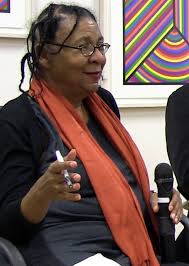
It's a well-known principle that no one else can love you if you don't love yourself. But most of us have assumed we need another person's love to fill the emptiness in ourselves. hooks believes that as we develop our ability to love we should be developing the ability to apply that love to ourselves, treating ourselves as well as we treat a loved one, and treating the loved ones as we would treat ourselves. (There are many echoes of Christian views on love in hooks's work.)
Also unexpectedly, in the chapter on Commitment hooks gets into the topic of how typical modern Americans work in the late 20th century. She thinks that our work lives are rarely organized around any loving principle or any principle that could easily increase love. As Karl Marx suggested, modern works leads us to be competitive typically and puts us into demeaning roles where we are doing what we are told for the sake of a boss or other authority figure, in the worst cases without even fully understanding or believing in what we are doing all day.
So as part of her chapter on commitment, she encourages us to commit to making our work something we love or something that expresses our love. She recognizes how improbable and far-fetched this sounds to people.
When I first declared my desire to work in a loving environment, friends acted as though I had truly lost my mind. To them, love and work did not go together. But I was convinced that I would work better in a work environment shaped by an ethic of love.
She dialogues a bit with another bestseller: Marsha Sinetar's 1989 book Do what you love and the money will follow whose popularity spoke to how little of most people's work lives had anything to do with what they loved.
it is equally true that we can do what we love and money will not always follow. Although this is utterly disappointing, it can also offer us the experiential awareness that doing what you love may be more important than making money. Sometimes, as has been the case in my life, I have had to work at a job that is less than enjoyable in order to have the means to do the work I love.
Let's hear that again: doing what you love may be more important than making money. Is that simply unrealistic romanticism when you have bills to pay? A big part of your commitment to loving yourself, as hooks sees it, is finding a love-positive form of employment. At least in 20th century capitalist America this is not at all an easy thing, especially if you don't come from privilege to begin with. A lot of jobs can make us feel despised and encourage our own worst forms of self-hatred. Many people are mainly focused on getting lucrative jobs so that some day they will not have to work. In how many cases do they end up spending their lives doing work they don't love in the hope that someday they will not have to do hated work?
Jobs depress the spirit. Rather than enhancing self-esteem, work is perceived as a drag, a negative necessity. Bringing love into the work environment can create the necessary transformation that can make any job we do, no matter how menial, a place where workers can express the best of themselves. When we work with love we renew the spirit; that renewal is an act of self-love, it nurtures our growth. It’s not what you do but how you do it.
Employers, however, do not tend to be interested in increasing love. They want to increase revenues, efficiency, and other values that are generally not concerned with love, or may even be destructive of it.
Perhaps hooks's feelings about commitment could be summarized in a take-off on Sinetar's title, Love yourself, and the love of others will follow. In any case, loving yourself is already a huge triumph of love, and one that many of us struggle our whole lives to achieve, and perhaps never do.
Self-love is the foundation of our loving practice. Without it our other efforts to love fail. Giving ourselves love we provide our inner being with the opportunity to have the unconditional love we may have always longed to receive from someone else.
Romance
I won't look closely at the ideas in hooks's other chapters, with the exception of her chapter on Romance. Most people gravitating to this book were probably looking for wisdom and tips on how they could get or enhance this kind of love, Romantic Love. (Two people - typically - in a loving partnership, typically to the exclusion of others. This is the couple variant on the isolated self-sufficient individual: narcissisme à deux (I am doing a little take-off here on the term folie à deux, a rare psychological disorder in which two people together share a delusion. "You and me against the world.")
One thing I would say, as much as I admire it, is that I often find All about Love a very heavy and sometimes even heavy-handed book. There is little appreciation by hooks for the fun to be had in romance, even if the romance is more flitation, play, dalliance, i.e. not necessarily based in the ideal of love she wants to promote. It is not clear if hooks could accept the possibility that two people can choose to hook up and enjoy one another's company, engage in erotic play, and grow together or apart without having touched the deepest bottom of love together. In her idealism and her will to make up for the love that was lacking in her childhood, she sometimes seems to ignore the positive joy that "romance" - perhaps almost as opposed to "love" - can bring. She really wants nothing less than to re-shape our world - which she would see as hate-based, power-based, and ultimately fear-based - on the principles of loving growth and care for the self and others. Without change to our society and how our culture thinks of human life, romance may become another distraction, like shopping and watching television. Personally, I think it is a better distraction than those things, and can lead us to a deepening and expansion of ourselves and of others. But coupling is a small growth of love at best, in a world that needs much more love as its centre.
Discouraged by her own series of romantic relationships with men, hooks sometimes seems to think that romance is a false idol:
TO RETURN TO love, to get the love we always wanted but never had, to have the love we want but are not prepared to give, we seek romantic relationships.
…
So many seekers after love are taught in childhood to feel unworthy, that nobody could love them as they really are, and they construct a false self. In adult life they meet people who fall in love with their false self. But this love does not last. At some point, glimpses of the real self emerge and disappointment comes.
Romantic love as it is popularly represented in the media is a mystery, something that Fate controls, unanalyzable "chemistry," a sometimes self-destructive but thrilling infatuation, something that happens to us or that we "fall into." All of these delightful views of love disregard the fact, as hooks sees it, that love is an action and a choice you make, not something over which you have no control or against which you are powerless. hooks can admit that love can be a mystery, but she thinks you can also look for it, rather than waiting for it to come to you, and that you can choose it in some cases, will it into being if you have a partner who is worth the effort.
In her first book, The Bluest Eye, novelist Toni Morrison identifies the idea of romantic love as one “of the most destructive ideas in the history of human thought.” Its destructiveness resides in the notion that we come to love with no will and no capacity to choose. This illusion, perpetuated by so much romantic lore, stands in the way of our learning how to love. To sustain our fantasy we substitute romance for love.
Many men, in particular, according to hooks, have been brought up to think that erotic attraction is the key to love, or that someone who turns them on is the same as someone they are in love with and who will love them back. In my own lifetime, this was pretty much always my way into a loving relationship, and I have rarely if ever not gotten involved with a person primarily because I was turned on by her sexually or erotically. On the whole, this has led me into long-term relationships. I am too insecure and perhaps too honest to be a "player" and I enjoy love as much as I've enjoyed sex. Sometimes I wish I'd had more "conquests," and fewer long-term relationships, but that would also have been part of my performative masculinity, proving (to other men, and to myself) that I am a real man because of the women I can get, in spite of my lack of "man's man" characteristics, and indeed a very "feminine" romanticism and emotional openness.
EROTIC ATTRACTION OFTEN serves as the catalyst for an intimate connection between two people, but it is not a sign of love. Exciting, pleasurable sex can take place between two people who do not even know each other. Yet the vast majority of males in our society are convinced that their erotic longing indicates who they should, and can, love. Led by their penis, seduced by erotic desire, they often end up in relationships with partners with whom they share no common interests or values. The pressure on men in a patriarchal society to “perform” sexually is so great that men are often so gratified to be with someone with whom they find sexual pleasure that they ignore everything else.
Again, I am impressed with hooks's understanding and empathic response to the sometimes desperate attitude men can have about sexual "performance." hooks is insistent that sex is not love, and that they do not necessarily entail one another.
The best sex and the most satisfying sex are not the same. I have had great sex with men who were intimate terrorists, men who seduce and attract by giving you just what you feel your heart needs then gradually or abruptly withholding it once they have gained your trust. And I have been deeply sexually fulfilled in bonds with loving partners who have had less skill and know-how. ... Enlightened women want fulfilling erotic encounters as much as men, but we ultimately prefer erotic satisfaction within a context where there is loving, intimate connection. If men were socialized to desire love as much as they are taught to desire sex, we would see a cultural revolution.
For hooks, love is a work and a project. You can't be dragged into true love by your dick or by your fantasies of being saved or by your hope of changing the other person into someone you will actually feel love with. In a relationship, in my experience, you will change the other person, but you certainly can't shape them exactly as you want. You will also be changed by them, and part of what love seems to mean to hooks is being open to this change in yourself, spiritual growth.
‘… True love accepts the person who now is without qualifications, but with a sincere and unwavering commitment to help him to achieve his goals of self-unfoldment—which we may see better than he does.” [Eric Butterworth] Most of the time, we think that love means just accepting the other person as they are. Who among us has not learned the hard way that we cannot change someone, mold them and make them into the ideal beloved we might want them to be. Yet when we commit to true love, we are committed to being changed, to being acted upon by the beloved in a way that enables us to be more fully self-actualized. This commitment to change is chosen. It happens by mutual agreement. Again and again in conversations the most common vision of true love I have heard shared was one that declared it to be “unconditional.” True love is unconditional, but to truly flourish it requires an ongoing commitment to constructive struggle and change.
For hooks, true love is actually a personal choice, and it is a choice that most of us are afraid to make. As with the commitment to our true selves (for instance, as Nietzsche proclaimed), commitment to true love of another requires courage many people cannot manage.
As long we are afraid to risk we cannot know love. Hence the truism: “Love is letting go of fear.” Our hearts connect with lots of folks in a lifetime but most of us will go to our graves with no experience of true love. This is in no way tragic, as most of us run the other way when true love comes near. Since true love sheds light on those aspects of ourselves we may wish to deny or hide, enabling us to see ourselves clearly and without shame, it is not surprising that so many individuals who say they want to know love turn away when such love beckons.
Redemption
Fundamentally, for hooks love is about embracing truth. (This strangely ties her back to the opening GNED lecture on Plato!) The truth of ourselves, the truth of our lives, the truth of our need and vulnerability and longing, the truth of our responsibilty and our ability to act. On the personal level, this is about not being afraid to be who we are and to love ourselves and be loved for that instead of one of our idealized performative masks. On the social and global level it is something closer to the Christian ideal of love as a redeeming force of healing. Love can come out of the suffering that brings personal growth and realism to a person.
In his collection of essays The Fire Next Time, James Baldwin writes about suffering in the healing process, stating: “I do not mean to be sentimental about suffering—but people who cannot suffer can never grow up, can never discover who they are.” Growing up is, at heart, the process of learning to take responsibility for whatever happens in your life. To choose growth is to embrace a love that heals.
You can perhaps see the underpinnings of the existentialist "religion" of the 20th century here: learning to take responsibility for yourself, including who you are, including your love or lack of love. There is no Cupid out there waiting to strike you with his arrow.
hooks moves beyond the small circle of your own love life, to address the lovelessness of the human project as evidenced by late 20th century American capitalism. The media does not tend to represent love as a realistic possibility. It is all about fantasies of self empowerment or self-sacrifice as the meaning of love. It does not represent happy loving families or honest loving partnerships as often as it presents dysfunction and selfishness as the norms. This was perhaps especially true in the televison dramas of the 90s. Viewers became hooked on dysfunction, perversity, even psychosis (serial killers, mob bosses, and so on). Few attempts were being made to show ordinary people in loving and caring relationships that weren't dysfuctional and based on abuse of power. (Though you could find some images of this kind of love in situation comedies.) hooks dreams of a world where the media presents positive, honest portrayals of loving relationships, and promotes public figures who are loving, rather than merely powerful, sexy, or admirably self-serving. We have lost touch with images of functional loving families and become addicted to images of dysfunction and abuse.
When we collectively move our culture in the direction of love, we may see these loving families represented more in the mass media. They will become more visible in all walks of daily life. Hopefully, we will then listen to these stories with the same intensity that we have when we listen to narratives of violent pain and abuse. When this happens, the visible happiness of functional families will become part of our collective consciousness.
All over the world people live in intimate daily contact with one another. They wash together, eat and sleep together, face challenges together, share joy and sorrow. The rugged individual who relies on no one else is a figure who can only exist in a culture of domination where a privileged few use more of the world’s resources than the many who must daily do without. Worship of individualism has in part led us to the unhealthy culture of narcissism that is so all pervasive in our society.
The whole nation, the whole world increasingly, needs to change course, to change its values, needs to grow spiritually and change. hooks speaks to Americans at the turn of the millennium:
As a nation, we need to gather our collective courage and face that our society’s lovelessness is a wound. As we allow ourselves to acknowledge the pain of this wound when it pierces our flesh and we feel in the depths of our soul a profound anguish of spirit, we come face to face with the possibility of conversion, of having a change of heart. In this way, recognition of the wound is a blessing because we are able to tend it, to care for the soul in ways that make us ready to receive the love that is promised.
The wound that is hidden under the flashy designer clothes of American culture is the wound of unlove, of abuse. The unloving treatment of the indigenous peoples, the unloving treatment of Africans, the unloving treatment of women and children, the unloving and uncaring attitude to nature and the environment. All in the name of more power and wealth, individual supremacy. To heal that wound and move in the direction of a loving world, we must first acknowledge and accept the shame of the past and we must renounce the dream of domination to embrace the dream of communion and love.
Now that's some self-help book!
The transformative power of love is not fully embraced in our society because we often wrongly believe that torment and anguish are our “natural” condition. This assumption seems to be affirmed by the ongoing tragedy that prevails in modern society. In a world anguished by rampant destruction, fear prevails. When we love, we no longer allow our hearts to be held captive by fear. The desire to be powerful is rooted in the intensity of fear. Power gives us the illusion of having triumphed over fear, over our need for love.
To return to love, to know perfect love, we surrender the will to power. It is this revelation that makes the scriptures on perfect love so prophetic and revolutionary for our times. We cannot know love if we remain unable to surrender our attachment to power, if any feeling of vulnerability strikes terror in our hearts.
This does make sense to me. Only in trying to accept my own vulnerability, even love it, have I been able to understand the reality of our shared human experience, and our community and commonness, a true love of humanity.
The will to grow and change
Nietzsche's will to power is often embraced for its more "toxic masculinity" possibilities - strength, domination, ego. But I don't think Nietzsche himself always, or maybe even mainly, saw it that way. The Will to Power could be interpreted in a number of ways that focus on growth, the drive to grow. But it doesn't have to be growth in domination, wealth, exploitation, population and consumption. What about the will to power as a drive to grow in wisdom, compassion, care, realism, vulnerability, openness, and love? I think Nietzsche might have been behind those things as well (at least at times; he is not a consistent thinker).
I feel that a central theme I kept coming back to in reading All about Love was actually: change. We should change - not for the worse, but in the ways I listed above. And maybe that even is what love is. The will to change oneself and another person, to grow, to grow up.
For hooks, to practice a Love Ethic requires examining every aspect of our lives—work, consumption, relationships, political engagement—through the lens of love. Does an action nurture growth? Does it demonstrate care and respect? Does it honour the interconnection of all beings?
Clearly this is not the ethic we have been thrown into in contemporary Western culture. Capitalism encourages exploitation. Patriarchy encourages domination. White supremacy and objectification of women encourage dehumanization. People believe only in the will to dominate, win, subjugate and exploit everything not-them. hooks insists that for the good of ourselves, each other, and the planet we must let go of the will to dominate, and embrace the will to love. One of the lessons I took from her book, and that I will ask a question on the final about, is what I think a key idea in her will to love is. I think it is
the will to change
The meaning of life is not to increase your power but to increase your love. You're not given this life to make money; you're given it to make love. Change is needed. And even small change helps, as the street person says. Love means having the courage to let go, to keep growing, to take some responsibility for your life and your world. Love is change.
CHANGE IS LOVE
That's not hooks talking, that's me. But I would like to think it is consistent with her message, and that I have been changed in positive ways by her powerful and loving book.